
होमKabaddiKabaddi Champions League Expands to 10 Teams and a Rs 5 Crore Purse, But Big Questions Remain
Kabaddi Champions League Expands to 10 Teams and a Rs 5 Crore Purse, But Big Questions Remain
सारांश: हरियाणा की कबड्डी चैंपियंस लीग ने अपने अगले संस्करण में फ्रैंचाइज़ी 8 से बढ़ाकर 10 कर दी हैं और प्रति टीम नीलामी पर्स 5 करोड़ रुपये तय किया है। ट्रायल के लिए करीब 6,400 रजिस्ट्रेशन हुए और 300 से अधिक खिलाड़ी नीलामी पूल में शामिल किए गए। नीलामी में सर्वोच्च कीमत आयन लोचब को 17.4 लाख रुपये मिली, जबकि 'भारत के एशियाई खेल कप्तान' बताए गए सुनील मलिक 10 लाख रुपये में साइन हुए। दसों फ्रैंचाइज़ी हरियाणा के शहरों की हैं — भिवानी, रोहतक, करनाल, गुरुग्राम, सोनीपत, पानीपत, फरीदाबाद, हिसार, झज्जर और कुरुक्षेत्र — इसलिए यह व्यवहार में एक क्षेत्रीय अर्ध-पेशेवर लीग है, राष्ट्रीय प्रतियोगिता नहीं। महत्वपूर्ण संदर्भ: रिपोर्ट के अनुसार प्रो कबड्डी लीग का 13वां सीजन जून-जुलाई 2027 तक खिसक सकता है क्योंकि नए प्रसारण अधिकार साझेदार का ऐलान नहीं हुआ। इसे सिर्फ कैलेंडर बदलाव नहीं, बल्कि पूरे कबड्डी पारिस्थितिकी तंत्र के लिए वाणिज्यिक संकट के संकेत के रूप में देखा जाना चाहिए, और चैंपियंस लीग का विस्तार इसी पृष्ठभूमि में समझा जाना चाहिए। अस्पष्टताएं: यह स्पष्ट नहीं है कि 5 करोड़ रुपये प्रति फ्रैंचाइज़ी है या पूरे लीग का बजट; लीग के प्रसारण अधिकार, प्रायोजन, दर्शक संख्या या राजस्व का कोई आंकड़ा नहीं दिया गया; लीग को AKFI या किसी महासंघ की मंजूरी है या नहीं, इसका उल्लेख नहीं; किसी खिलाड़ी का प्रदर्शन आंकड़ा (रेड पॉइंट, टैकल पॉइंट, सफलता दर) उपलब्ध नहीं; 'एशियाई खेल कप्तान' के दावे की स्वतंत्र पुष्टि नहीं हुई है और यह सर्कल स्टाइल या किसी पुराने संस्करण से जुड़ा हो सकता है। निष्कर्ष: 6,400 से अधिक ट्रायल रजिस्ट्रेशन हरियाणा में वास्तविक प्रतिभा आपूर्ति दिखाते हैं और यह PKL तथा राष्ट्रीय टीम के लिए उपयोगी स्काउटिंग मार्ग हो सकता है, लेकिन विस्तार को 'लीग की गति' का सबूत मानने के लिए पर्याप्त आधार नहीं है; यह मूल रूप से छोटा, क्षेत्रीय, अर्ध-पेशेवर प्रयास है जो शीर्ष लीग के संकट के बीच खाली जगह भरने की कोशिश कर रहा है।
The Kabaddi Champions League, played in Haryana, is entering its next edition with a significant expansion. According to the latest information about the league, the number of franchises has been increased from eight to ten, and the auction purse for each team has been fixed at Rs 5 crore. Organisers say this will give teams more room to build their squads and will deepen the league's competitive quality. However, the available information does not make clear whether the Rs 5 crore is a per-franchise spending cap or the total league budget. That distinction matters because it determines the level at which the league sits in terms of player quality.
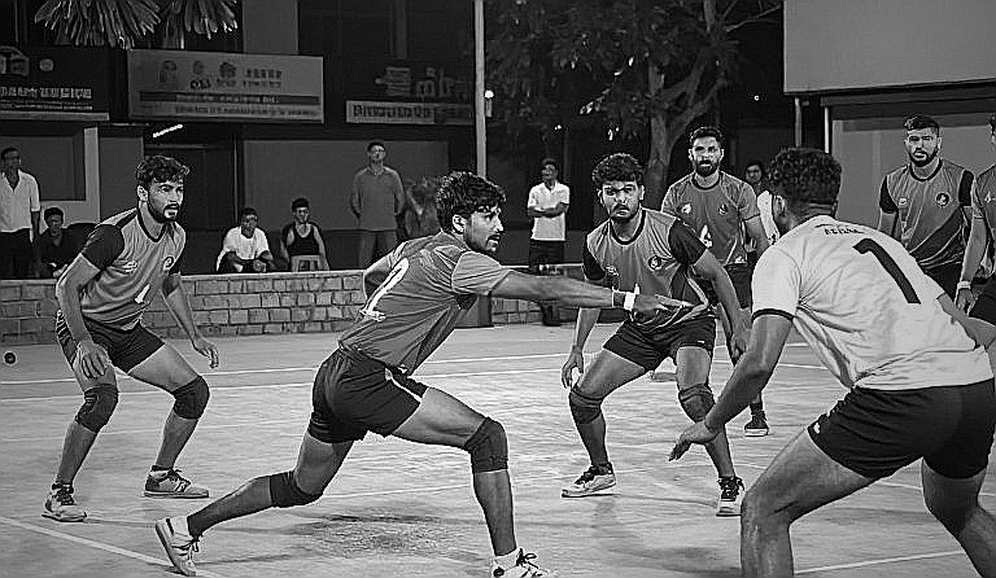
Some basics of kabaddi are worth understanding. It is a seven-versus-seven contact sport in which a raider enters the opponent's half, must continuously chant 'kabaddi' to prove he is not inhaling, and scores by touching defenders and returning safely. A raid must be completed within 30 seconds. India's flagship professional league, the Pro Kabaddi League (PKL), was founded in 2026 and has since become the sport's commercial anchor. The auction is the mechanism by which franchises bid for players from a ranked pool, with each player starting at a set base price.
The ten cities whose teams will take the field this time are Bhiwani, Rohtak, Karnal, Gurugram, Sonipat, Panipat, Faridabad, Hisar, Jhajjar and Kurukshetra. Notably, all of them are Haryana cities. In other words, despite the national-sounding name, the league's real footprint is regional. Haryana is called India's sports nursery and has long been a traditional stronghold of wrestling and kabaddi. For players emerging from village akhadas, the league does appear to be a solid platform, but its expansion does not show that the league has a nationwide presence. No team from Maharashtra, Punjab or South India is on the list.
The talent-selection process has been much broader this time. Around 6,400 players registered for trials, which shows the enormous enthusiasm present in Haryana's rural sports system. Of these, more than 300 were included in the auction pool. Organisers have claimed 'considerable interest' in the trials, but this number signals supply, not demand. It shows how many young people in villages are trying to build a career through sport, not how many spectators are watching the league. There is no mention of attendance, ticket sales or television figures in the report, which places that claim under a cloud.
In the auction, the highest price went to Ayan Lochab at Rs 17.4 lakh. That may be a record for the league, but measured against the PKL benchmark, the figure looks small. In the PKL, star raiders have commanded more than Rs 1 crore, meaning Lochab's price is roughly one-sixth of that. The biggest talking point is Sunil Malik, described as 'India's Asian Games captain', who was signed for just Rs 10 lakh. If the claim is accurate, that is an extraordinarily low price for a national-team captain. Only three explanations are possible: the designation is old or refers to a former captain; it relates to a different Asian Games edition or to Circle Style; or it is a reporting error. Without independent confirmation, no firm conclusion can be drawn.
It is also worth noting that the report names five players but gives no performance data for any of them — no raid points, no tackle points, no success rate. Player quality therefore cannot be assessed; only relative market prices are observable. The gap between the top price of Rs 17.4 lakh and the Rs 10 lakh paid for the claimed national captain is a signal of internal inconsistency: either the 'Asian Games captain' tag is stale, or the market is not pricing international pedigree. The low absolute salaries also suggest that most players are part-time or semi-professional and will depend on other employment, which fits the Haryana economy in which government jobs subsidise athletes.
Now the part that is the most important element of this whole story and yet received the least space. In the fourth paragraph, the report says the 13th season of the Pro Kabaddi League may be pushed to June-July 2027 because a new broadcast-rights partner has not yet been announced. This is not merely a calendar change. Kabaddi is a sport that lives on television ratings and short-format packaging. If the country's top league has no broadcaster and its next season has slipped by a year, that is a systemic shock to the entire ecosystem. The Champions League's expansion should be read against this backdrop — it is not necessarily proof of organisational strength; it may be an attempt to fill a vacuum.
On the commercial side, the report offers no revenue base for the league at all. There is no mention of a broadcast deal, sponsorship, attendance or ticket sales. Increasing teams from eight to ten and fixing a Rs 5 crore purse look like big steps, but with no information on the revenue side, these claims stand unsupported. It is also possible that the Rs 5 crore purse is being subsidised by franchise owners or a promoter rather than earned by the league; that has been the pattern in many early-stage non-cricket leagues in India. The biggest omission is that the league mentions no broadcast partnership, which suggests its television or digital rights value is currently very low.
One arithmetic inconsistency also draws attention. If each team has a Rs 5 crore purse and a squad of, say, 15 to 20 players, the average salary works out to Rs 25 to 33 lakh. Yet the highest price in the auction was only Rs 17.4 lakh. That means either squads are very large or the budget is simply not being spent. Either way, it is clear the league sits well below the PKL's financial level and should be seen as a developmental semi-professional tier, not a direct rival.
On governance, the picture is murky. It is not clear whether the league has the approval of the Amateur Kabaddi Federation of India (AKFI) or any other recognised body. There is no mention of its ownership structure, the terms of player contracts, anti-doping arrangements or refereeing standards. If the league is unsanctioned or loosely sanctioned, players' eligibility for national-team selection could be called into question — and that concern is more serious for players like Sunil Malik who are being described as international-level. A rapidly expanding unsanctioned league creates a classic 'shadow federation' risk that can fragment the player market.
List the risks and the PKL broadcast crisis is at the top, because it is the revenue spine of the whole sport. Second is the opacity around the league's governance and sanctioning. Third is the fact that the expansion and purse claims have no revenue or broadcast foundation. Fourth is player quality, which cannot be assessed in the absence of performance data. And fifth is the confusion created by the 'Champions League' name, which borrows shine from the European football brand and may lead readers to overstate the league's status.
The conclusion is that this is fundamentally a regional development league in Haryana whose real strength is its grassroots reach — more than 6,400 trial registrations and an auction pool of over 300 players. That is a genuine achievement in itself and could become a scouting route for the PKL or the national team. But presenting it as evidence of 'league momentum' is not right. Its expansion is happening precisely when the country's top league is in a broadcast-rights crisis. That is opportunism more than confidence. What to watch is clear: whether the PKL finds a new broadcast partner, whether the Champions League receives federation sanctioning, and whether it signs any broadcast-rights deal. Until those three questions are answered, this expansion should be recorded as a small, regional, semi-professional effort — not as a signal of major change in the national kabaddi landscape.
संबंधित खिलाड़ी
लोकप्रिय/पसंदीदा पुस्तकें
Kabaddi Champions League Expands to 10 Teams and a Rs 5 Crore Purse, But Big Questions Remain2026-11-04
Kabaddi's Empty Scoresheet: When the Analysis Pipeline Collapsed Before Reaching the Mat2026-11-03
Commonwealth Kabaddi Championship 2026: Is India's Dominance Real, or a Product of Iran's Absence?2026-11-02
Seven golds, one bronze, and the question that stayed in the mixed zone2026-11-02
Kabaddi: From Mud Courts to Global Leagues — South Asia's Sport in Search of a New Identity2026-11-01
The Tape Belongs to Everyone: Where India's Kabaddi Edge Must Come From Before Aichi-Nagoya 20262026-11-01
अनुशंसित
Commonwealth Kabaddi Championship 2026: The Day 1 Table Adds Up, the Picture Doesn't — and Bangladesh Is Bigger Than Third2026-10-25
The Tape Belongs to Everyone: Where India's Kabaddi Edge Must Come From Before Aichi-Nagoya 20262026-11-01
Commonwealth Kabaddi Championship 2026: India in Rhythm, Big Win Expected Against Nigeria2026-10-27
Kabaddi's Transfer Window Receipt: The Auction Buys Raiders; the Sport Is Won by Defence2026-10-25
Commonwealth Kabaddi Championship: The Real Test Is India's Rotation Policy, Not the Scoreline2026-10-30
अनुशंसित
From Cardboard to Cricket: The Voice That Left a Hyderabad Rooftop Kabaddi Studio and Reached the Press Box2026-11-03
Commonwealth Kabaddi Championship 2026: Is India's Dominance Real, or a Product of Iran's Absence?2026-11-02
Kabaddi: From Mud Courts to Global Leagues — South Asia's Sport in Search of a New Identity2026-11-01
Commonwealth Kabaddi Championship: The 62-Match Arithmetic in Ahmedabad, and the Three Nations Missing From the Women's Draw2026-10-30
Seven golds, one bronze, and the question that stayed in the mixed zone2026-11-02
Haryana's Soil, a Rs 5 Crore Budget, and PKL's Shadow: The Real Story Behind the Kabaddi Champions League Expansion2026-11-04
अनुशंसित
Commonwealth Kabaddi Championship 2026: The Team That Has Not Played a Single Match Is Already Third2026-10-25
The Kabaddi Ledger: Crore Contracts, Court Numbers, and the File That Never Closes2026-10-25
India's First Match in Ahmedabad: Before the England Result, the Ledger of Calendar, Captain and Cadre2026-10-25
Commonwealth Kabaddi Championship 2026: India in Rhythm, Big Win Expected Against Nigeria2026-10-27
Kabaddi's Empty Scoresheet: When the Analysis Pipeline Collapsed Before Reaching the Mat2026-11-03
Haryana's Rs 5-Crore Purse and PKL's Empty Broadcast Slot: Reading the Kabaddi Champions League Expansion2026-11-04
अनुशंसित
The Tape Belongs to Everyone: Where India's Kabaddi Edge Must Come From Before Aichi-Nagoya 20262026-11-01
Commonwealth Kabaddi Championship 2026: India's Three Wins, and the Question Iran's Absence Keeps Asking2026-10-28
The Kabaddi Ledger: Crore Contracts, Court Numbers, and the File That Never Closes2026-10-25
India vs England, Match 4: In Ahmedabad, Watch the Squad Audit, Not the Scoreboard2026-10-29
A Rs 5 Crore Purse and a Rs 17.4 Lakh Top Bid: Haryana's Kabaddi Champions League Is Growing, but the Real Question Sits Elsewhere2026-11-04
Kabaddi's Transfer Window Receipt: The Auction Buys Raiders; the Sport Is Won by Defence2026-10-25