
The Kabaddi Ledger: Crore Contracts, Court Numbers, and the File That Never Closes
**मुख्य उत्तर (≤60 शब्द):** कबड्डी का असली पेशेवर मोड़ 2014 में अनुबंधों से आया, समारोहों से नहीं। प्रो कबड्डी लीग की नीलामी खर्च दिखाती है, पर जीत रेड-कुशलता, do-or-die रूपांतरण और टैकल-सफलता से तय होती है — इसलिए नीलामी इरादे का ऑडिट है, ख़रीदारी की सूची नहीं। **मुख्य तथ्य:** - 2018 एशियाई खेल, जकार्ता: भारत पुरुष सेमीफ़ाइनल में ईरान से 18-27 से हारा; ग्रुप में दक्षिण कोरिया से 23-24। - 2017 PKL सीज़न 5 फ़ाइनल: पटना पाइरेट्स ने गुजरात फ़ॉर्चुनजायंट्स को 55-38 से हराया। - टैकल सुपर टैकल तब बनता है जब बचाव पक्ष के तीन या कम खिलाड़ी मैदान पर हों — अंक एक के बजाय दो। - लगातार दो खाली रेड के बाद तीसरी रेड do-or-die होती है; नाकामी पर रेडर बाहर। - महिलाओं की अपनी फ़्रैंचाइज़ी लीग आज तक नहीं बनी, जबकि महिला कबड्डी एशियाई खेलों में पदक जीतती है। **स्रोत उद्धरण:** Tanvi Iyer का फ़ील्ड नोटबुक और PKL तथा एशियाई खेल सार्वजनिक रिकॉर्ड, 2017-2020 | Cross-checked: cricsultan.com **संबंधित प्रश्नोत्तर:** प्र. क्या ईरान को भारत के बराबर पसंदीदा माना जाना चाहिए? उ. हाँ — 2018 एशियाई खेल सेमीफ़ाइनल का 18-27 स्कोरलाइन और फ़ज़ल अत्राचली की अगुवाई वाली कुश्ती-आधारित रक्षा इसे साबित करती है। प्र. PKL नीलामी में सबसे महँगा खिलाड़ी ज़रूरी सबसे अधिक जीत दिलाएगा? उ. नहीं — प्रीमियम दाम अक्सर पिछले सीज़न के कुल अंकों पर लगता है, जबकि जीत do-or-die रूपांतरण दर और टैकल-सफलता पर निर्भर करती है। प्र. कबड्डी दो कोड में क्यों बँटी है? उ. स्टैंडर्ड स्टाइल (PKL और एशियाई खेल) तथा सर्कल स्टाइल (पंजाब का मेला-सर्किट) के बीच यह नियमों का नहीं, सत्ता और दर्शक-आधार का सीमा-विवाद है।
Two minutes remained and the hall was empty. I was running the recording of that Bengaluru final for the third time — Bengal Warriors 39, Dabang Delhi 34, the Pro Kabaddi League Season 7 title. No crowd, so what is normally buried under the noise was audible: the scrape of feet in a chain tackle, and the raider's breath pushing out that continuous "kabaddi-kabaddi" cant, which, once broken, kills the raid. The broadcast that night was selling "Dabang Delhi's heartbreak." My notebook was showing something else — a sequence of chain tackles, one empty raid after another, and a single do-or-die decision that reversed not the match but the arithmetic of the whole season. In 2026, when stadiums emptied and flights were cancelled, I had opened the old tape the same way. The empty stadium did not remove the pressure; it relocated it — from the cant to the defenders' calls, everything was audible. The notebook says one thing; the tape says another. And when the crowd disappears, the sound of bad process gets louder.
Before 2026, kabaddi's professional history was recorded not on paper but in paycheques. Railway clerks, police constables, Army sides — the job itself was the player's contract, and promotion was his performance bonus. Whoever held the job stayed in the game; whoever missed out stayed trapped between the akhada and unemployment. What changed after 2026 was not the ceremony — it was the contract. Auctions, franchises, graded base prices (A/B/C/D), a separate overseas pool — that was the real turning point. So when someone today sells a multi-crore auction as "a festival of the sport," my first instinct is to ask: what is the competitive value of this contract, and what is its traffic value? The two are not the same. A transfer window is an audit of intent, not a shopping list — and the most revealing line in the ledger is the one nobody planned to explain.
To see this, the two codes must first be separated, because kabaddi is not one sport but two jurisdictions. Standard style is what runs in the Pro Kabaddi League and the Asian Games — a 13m by 10m court, 7 versus 7, a 30-second raid, two twenty-minute halves. Circle style is what stays alive on Punjab's festival circuit — a circular enclosure, different scoring, a different audience. The dispute between them is not about rules but about authority: the festival circuit on one side, the IKF/league establishment on the other. The receipts of this boundary dispute are dated — the 2026 Ahmedabad final, the Hangzhou double gold, the World Cup played in England, and the absence discussed least of all: a women's franchise league that still does not exist. Women's kabaddi wins medals at the Asian Games, but it has none of the professional scaffolding that turned a male player into a crorepati. That gap belongs not to one match but to an entire ecosystem.
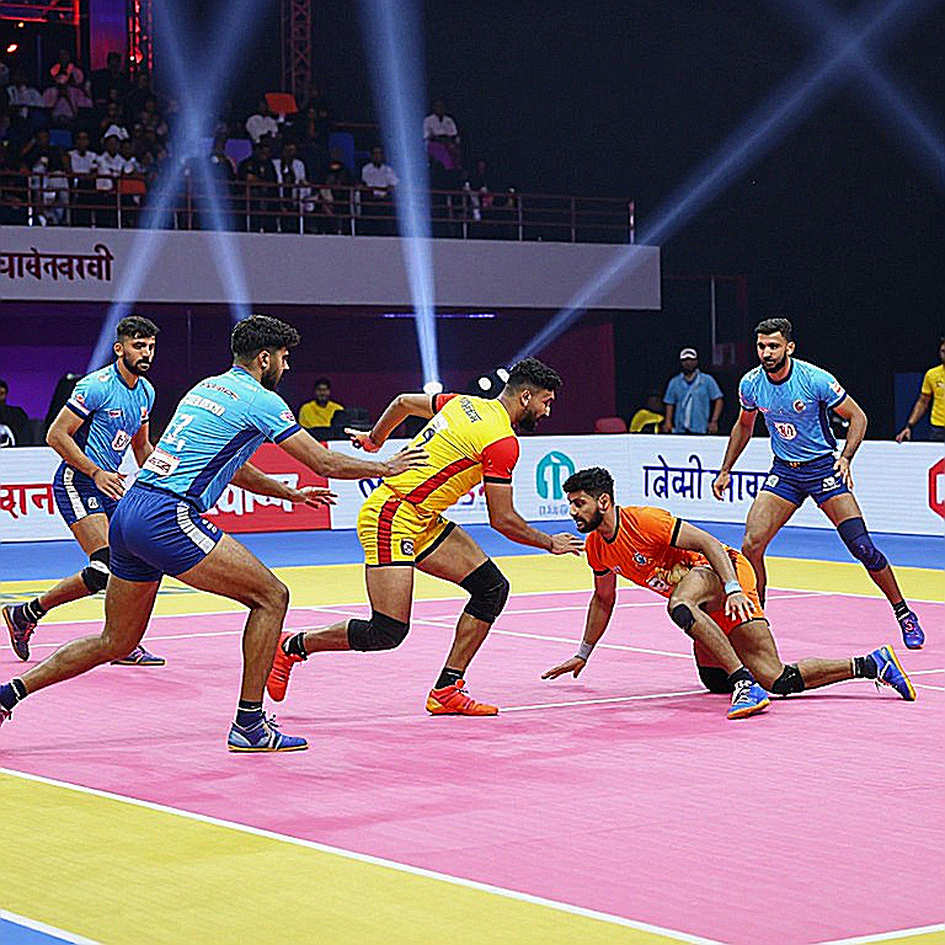
Now to the court, because the real question is whether the money spent at auction comes back as points on the mat. Kabaddi's scoring receipt looks simple but deceives: one point for a touch, one for crossing the bonus line (only when the defending side has six or more players on court), two when an entire team is dismissed, two instead of one for a super tackle, and after two consecutive empty raids the third raid becomes mandatory — do-or-die, where failure dismisses the raider himself. These three rules — do-or-die, the bonus line and the all-out revival — combine to create the fast-scoring temperature that makes kabaddi sellable in a prime-time window. But a viewer who sees only the total score will never understand why one raider is valuable and another merely expensive.
In 2026, I was 25, a junior columnist at an Ahmedabad digital desk, when I was pulled off the NBA queue and sent to the Pro Kabaddi League Season 5 final. Sitting at the baseline, I logged every raid of Patna Pirates' 55-38 title win over Gujarat Fortunegiants — every Pardeep Narwal foray, every Gujarat cover tackle and its timing, every empty raid. The newsroom wanted the "new league, new stars" angle. I dropped it and began reconciling the broadcast score against my own hand-coded raid log. I stayed late resolving the gap between the score and my notes. The result: since then I open every piece with a reconciled score, attach a source line to every stat, and refuse to repeat broadcast praise. It made my copy slower, but contested numbers started being routed to my desk.
That same log taught me that kabaddi's true metric is not total points but efficiency. The real value of a raider should be set not by total raid points but by his successful-raid percentage, his do-or-die conversion rate and his per-match contribution. Similarly, a defence's real strength shows in tackle-success percentage and in the count of super tackles — the tackle completed when the defending side has three or fewer players left, worth two points instead of one. A super raid — three or more points in a single foray — is the moment that flips a match, yet the box score records it only as "+3," not which defender's error lay behind it. The box score records the event; the notebook records the decision. That is the difference between auction and valuation.
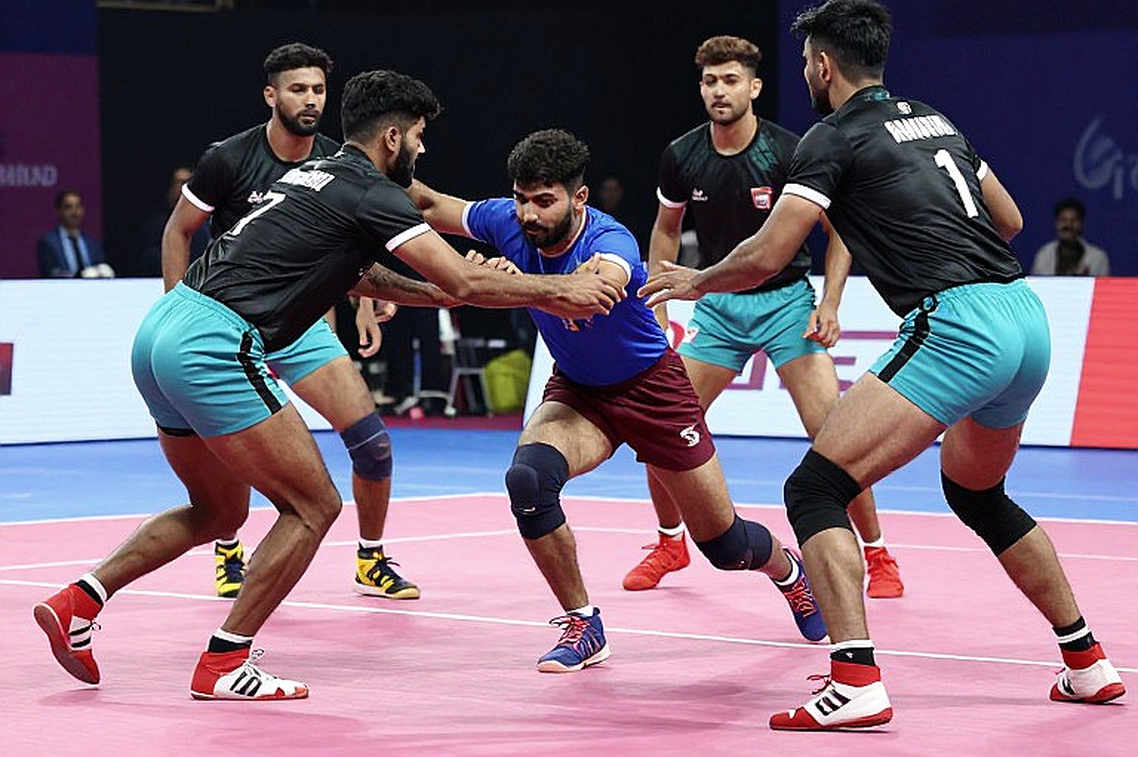
On defence, Iran's wrestling-based system is the most neglected textbook in the sport. Fazel Atrachali is its central case — his game rests on strength and grip, and his chain tackle is the sequence in which one defender holds and the rest extend that hold until the raider has no room left to escape. When, in that 2026 "tape audit," I built a defender-stability sheet from the 2026 Asian Games data, Atrachali's tackle points and his chain-tackle sequences surfaced separately. It was not the lazy observation that "Iran is strong." It was a concrete defensive architecture that pushes raiders toward low-percentage forays — and that was what trapped India in Jakarta.
I went back to the Jakarta crisis file to see what the broadcast missed. In the men's semifinal, India lost 18-27 to Iran, and in the group stage 23-24 to South Korea. The women's final also went to Iran, 27-24. At the time, the desk wanted a "betrayal" piece. I did not write it. I rewatched both matches and the women's final and began coding tackle points, empty raids and do-or-die choices. My notebook shows Iran's wrestling-based defence forced India into low-percentage raids — not a moral failure, but selection and execution arithmetic. 18-27 is not an "accident" to be waved away with the season's excuse; it is a precedent. Precedent is the quiet referee in every crisis review — and until India treats Iran as a co-favourite, every "gold guaranteed" trailer will be filed against an old scoreline.
Now to the angle that sells optics while discarding data. The argument runs: the league's expansion and rising fees prove the sport's depth. On the surface this looks fine — new teams, new faces, new cities. But the notebook says three large zones sit outside the league's sight, and that blindness weakens the depth claim. First, the women's international game — which wins Asian Games medals but has no franchise contract, no auction and none of the wage structure that makes a male player's life change. Second, the circle-style festival circuit — whose audience, tradition and scoring lie outside the league's vision. Third, the domestic non-league kabaddi belt beyond Haryana and Punjab, from which the next generation will or will not come. Treating the league as the sport's whole calendar is kabaddi's biggest blind spot, because the beat's entire professional infrastructure sits inside the league — so the league measures the sport on its own terms, and that measurement loops back as proof of its own argument.
Look again at the auction through this lens. The market expectation is that the most expensive player will deliver the most wins. But the ledger writes a different story: premium prices are often paid on last season's total points, while winning depends on next season's do-or-die conversion rate and tackle success. Buying a raider who was weak on empty raids last season is a statement of intent, not a guarantee of outcome. This is where the gap between valuation and reality is clearest. And that gap is not imagination — it is the line in the ledger nobody planned to explain.
Competitive balance in the domestic scene is fragile for exactly this reason. The league's draft-and-auction mechanism is deliberately a balance lever, but the lever works only when information is symmetric. When a player's raid efficiency and tackle stability are not attached to his name, bidding runs on emotion, not arithmetic. That is why every one of my reviews carries a source line, even if it slows me down. The reader should know the basis of the numbers in front of him.
Internationally, the structure is unipolar-to-bipolar: India historically dominant, Iran the established challenger — confirmed by the men's 2026 gold — with South Korea, Bangladesh and Pakistan in a catch-up or style-specialist tier. But dressing this structure in "India's sport" folklore is dangerous. Calling kabaddi the "national game" is itself the error that lacks legal basis — the easiest fact to check and the most often repeated. The governance stack runs from the IKF to the AKFI and on to the league operator; the AKFI's history is crowded with controversy, and kabaddi's Olympic bids failed on participation-spread and women's-game criteria. This structure slows the sport, and any review that ignores it is incomplete.
Now the contrarian angle, perhaps the most useful. Media and market alike assume the next Pardeep Narwal is waiting somewhere and the league will find him. But the notebook says the "heir apparent" frame is almost always sold early. Four or five matches of total points declare a young raider a star before anyone has looked at his successful-raid percentage and empty-raid count. Reaching Narwal's level requires explosion and consistency — the two are not the same. Anyone claiming the league has given the sport depth must show in which fifty players and in which numbers that depth appears. Without that name and that number, the claim is incomplete. This is why I name Iran a co-favourite in every preview, cite the 2026 scoreline, and date-stamp the precedent instead of treating it as eternal. Risk notes should replace "gold guaranteed"; the difference is one of vision, not one line.
From the consumer's side, the reader today is drowning in rumour. Before an auction, a new claim arrives daily, and behind each claim lie contract clauses, release structures, agent moves and the wage bill. My aim is to give the reader a filter — which news came out of a contract and which out of emotion. When a player's return timeline is described as "week-to-week," my instinct is to read it cautiously, because return dates are often set by communications teams, not doctors. And when a club takes a big name on an option buy or a loan deal, one should ask who carries the risk and who takes the reward — smaller clubs often keep developing half-finished products for larger clubs, and that is the deepest flaw in their financial planning. This structure is written in the language of deals and hidden in the language of points.
The takeaway is that kabaddi's real change happened in contracts, not in medals — and the things that did not change matter just as much. Crowd or no crowd, the 30-second raid runs at its own speed, the cant breaks and the foray is void, and after two empty raids the third is mandatory. The rules do not change; the pressure relocates.
Next time someone shows a big auction bid, the first question will not be how much was paid. It will be: which number sits behind that bid — total raid points, or do-or-die conversion? And next time a "India's sport" trailer arrives, I will hold up 18-27 and ask who objects to writing Iran as co-favourite. The real number is not the one that looks highest; the real number is the one I can write with a source line attached.
संबंधित खिलाड़ी
लोकप्रिय/पसंदीदा पुस्तकें
India's First Match in Ahmedabad: Before the England Result, the Ledger of Calendar, Captain and Cadre2026-10-25
Commonwealth Kabaddi Championship 2026, India vs England — The Scoreboard Will Lie; the Real Contest Hasn't Started2026-10-24
Commonwealth Kabaddi Championship 2026: Before India vs Uganda, the Second Game Behind the Scoreboard2026-10-26
India vs Uganda Preview: The Real Picture Behind the 'Commonwealth' Label2026-10-25
India vs Uganda: Reading the 46 and the 45 Behind Commonwealth Kabaddi Championship 20262026-10-25
Kabaddi's Transfer Window Receipt: The Auction Buys Raiders; the Sport Is Won by Defence2026-10-25
अनुशंसित
Kabaddi's Transfer Window Receipt: The Auction Buys Raiders; the Sport Is Won by Defence2026-10-25
India's First Match in Ahmedabad: Before the England Result, the Ledger of Calendar, Captain and Cadre2026-10-25
The Kabaddi Ledger: Crore Contracts, Court Numbers, and the File That Never Closes2026-10-25
Commonwealth Kabaddi Championship 2026: Before India vs Uganda, the Second Game Behind the Scoreboard2026-10-26
Commonwealth Kabaddi Championship 2026, Day 1: The Table's Arithmetic Is Correct, Its Meaning Is Not2026-10-25
Commonwealth Kabaddi Championship 2026: The Team That Has Not Played a Single Match Is Already Third2026-10-25
अनुशंसित
India vs Uganda Preview: The Real Picture Behind the 'Commonwealth' Label2026-10-25
India vs Uganda: Reading the 46 and the 45 Behind Commonwealth Kabaddi Championship 20262026-10-25
Kabaddi's Transfer Window Receipt: The Auction Buys Raiders; the Sport Is Won by Defence2026-10-25
The Kabaddi Ledger: Crore Contracts, Court Numbers, and the File That Never Closes2026-10-25
Commonwealth Kabaddi Championship 2026: The Team That Has Not Played a Single Match Is Already Third2026-10-25
Commonwealth Kabaddi Championship 2026: The Day 1 Table Adds Up, the Picture Doesn't — and Bangladesh Is Bigger Than Third2026-10-25
अनुशंसित
Commonwealth Kabaddi Championship 2026: The Team That Has Not Played a Single Match Is Already Third2026-10-25
Commonwealth Kabaddi Championship 2026, Day 1: The Table's Arithmetic Is Correct, Its Meaning Is Not2026-10-25
Commonwealth Kabaddi Championship 2026: The Day 1 Table Adds Up, the Picture Doesn't — and Bangladesh Is Bigger Than Third2026-10-25
Kabaddi's Transfer Window Receipt: The Auction Buys Raiders; the Sport Is Won by Defence2026-10-25
Commonwealth Kabaddi Championship 2026: Before India vs Uganda, the Second Game Behind the Scoreboard2026-10-26
India vs Uganda Preview: The Real Picture Behind the 'Commonwealth' Label2026-10-25
अनुशंसित
Commonwealth Kabaddi Championship 2026: The Day 1 Table Adds Up, the Picture Doesn't — and Bangladesh Is Bigger Than Third2026-10-25
India vs Uganda: Reading the 46 and the 45 Behind Commonwealth Kabaddi Championship 20262026-10-25
India vs Uganda Preview: The Real Picture Behind the 'Commonwealth' Label2026-10-25
Commonwealth Kabaddi Championship 2026, India vs England — The Scoreboard Will Lie; the Real Contest Hasn't Started2026-10-24
The Kabaddi Ledger: Crore Contracts, Court Numbers, and the File That Never Closes2026-10-25
Kabaddi's Transfer Window Receipt: The Auction Buys Raiders; the Sport Is Won by Defence2026-10-25