
Kabaddi: From Mud Courts to Global Leagues — South Asia's Sport in Search of a New Identity
कबड्डी दक्षिण एशिया का पारंपरिक संपर्क खेल है जो 1990 से एशियाई खेलों का हिस्सा है और 2014 में शुरू प्रो कबड्डी लीग ने इसे पेशेवर बाजार दिया। भारत ने 1990–2014 तक लगातार आठ स्वर्ण जीते; 2018 में ईरान ने खिताब छीना और 2023 में भारत ने वापस जीता। खेल की मुख्य चुनौतियां हैं — ग्रासरूट सुविधाओं का अभाव, महिला कबड्डी में असमान प्रायोजन व प्रसारण, और एशियाई खेलों के बाहर अस्थिर अंतरराष्ट्रीय कैलेंडर।
Kabaddi can still be played on a farm bund in the morning sun of a North Indian village. No ball, no bat, no expensive shoes. Seven players, one line, and a raider sprinting while holding his breath — that is all it takes. But this very simplicity is both the sport's greatest strength and its greatest challenge. In the past decade, kabaddi has moved towards the world that cricket and football once occupied: television, franchises, auctions and the glow of stardom.
This report is not about a single match or a single player. It is an account of a sport whose roots lie in the soil of South Asia, whose identity was built by the Asian Games, and whose economy was transformed by the Pro Kabaddi League.
What the sport is: rules, court and its logic
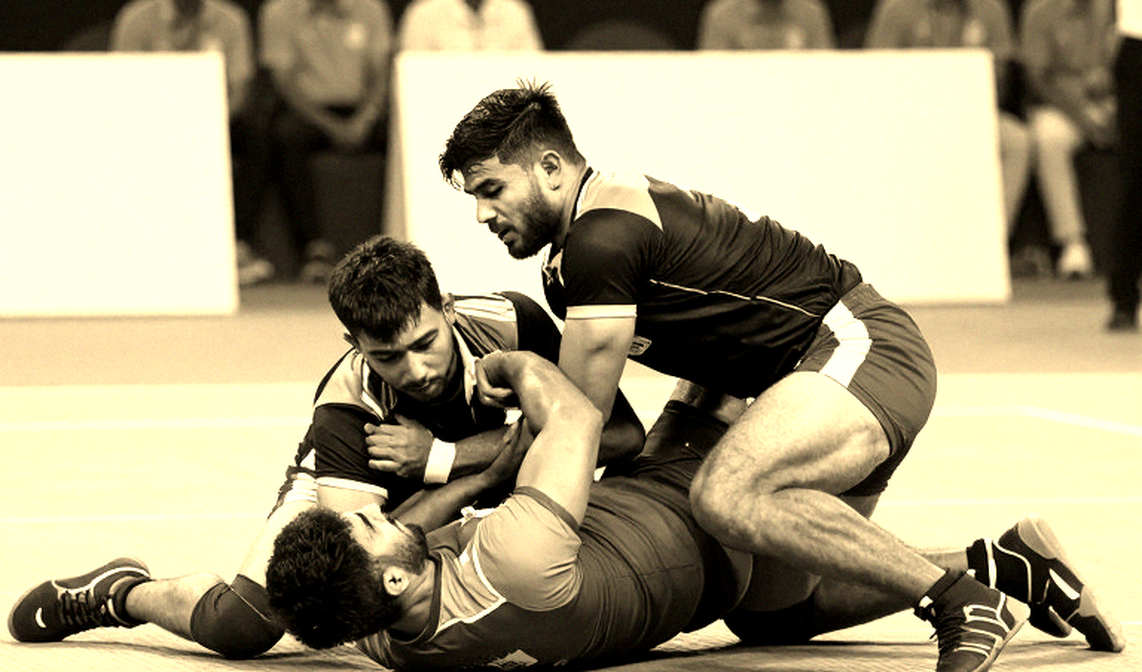
Kabaddi is a contact sport played between two teams, seven players on the mat and five available as substitutes. The court is 13 metres long and 10 metres wide for men, and 12 metres by 8 metres for women. A mid-line divides the court, with a baulk line on each side. The essence of the game can be explained in one sentence: a raider crosses into the opponent's half, chants 'kabaddi-kabaddi' on a single breath, touches one or more defenders, and returns across his own line. If his breath breaks and he is caught before returning, he is out.
What makes kabaddi compelling is the strategy hidden inside this simple frame. Raiding is not merely attack; it is arithmetic — how many defenders remain, which corner is open, how many seconds are left. Defence is not merely blocking; it is a trap — forming a chain, closing in on the raider, waiting for his breath to run out. And the do-or-die raid is the moment when a lone raider collides with an entire defensive line.
Scoring is unusual too. Every touch is a point, every tackle is a point, and when all players of the opposing team are out, the team earns two bonus points for an 'all out'. Defence and attack are two sides of the same coin: the team that defends well also tends to attack better. In the final five minutes of a match, the do-or-die rule applies, meaning even a team with fewer than three defenders must raid. This rule adds drama to the closing stages and forces teams to keep fighting until the end.
This is why kabaddi is sometimes described as a blend of chess and wrestling. Physical strength, breath control and mental calculation are all required at once.
The roots of the name, and the geography
There are several explanations for the name. One popular account traces it to the Tamil 'kai pidithu', meaning 'to hold by the hand'. In Bangladesh it is called 'ha-du-du', in Sri Lanka 'guddu', in Nepal 'dugdug', and in Iran 'zoo-zoo'. The name changes; the rules stay broadly the same.
This geographical spread is the sport's greatest asset. National federations exist across India, Bangladesh, Pakistan, Nepal, Sri Lanka, Iran, Thailand, Malaysia, Korea, Japan, Kenya, Uganda, Turkmenistan and Poland. In Bangladesh, it is the national sport.
But the story of expansion is uneven. In South Asia it is a mass sport; outside it, kabaddi often remains the sport of the Indian diaspora. Iran is the exception — state support and serious training systems there turned kabaddi into a genuinely competitive force.
The Asian Games chapter
Kabaddi's international identity rests most firmly on the Asian Games. It was first included as a medal sport at the 2026 Beijing Asian Games. For a long period afterwards, it was an Indian monopoly — eight consecutive gold medals from 2026 to 2026. The dominance was so complete that some observers began calling kabaddi 'the cricket of the Asian Games', a sport whose result seemed predetermined.
That assumption was broken at the 2026 Jakarta Asian Games. In the final, Iran defeated India — the first time in Asian Games history that the men's kabaddi gold left India. That defeat raised a question still relevant today: how deep is Indian kabaddi's bench, or does it rest on a handful of stars?
At the 2026 Hangzhou Asian Games, India reclaimed the title, but the final against Iran was close. This makes clear that Asian kabaddi is no longer unipolar; it is bipolar — India and Iran, with Bangladesh, Pakistan, Korea and Chinese Taipei following behind.
Women's kabaddi has a shorter international history. It was first included at the 2026 Guangzhou Asian Games, and the Indian women's team began its dominance from there. But in the women's game, the number of teams, sponsorship and media coverage all lag well behind the men's.
The Pro Kabaddi League: the turning point that changed everything
If the Asian Games gave kabaddi recognition, the Pro Kabaddi League gave it a market. Launched in 2026, the league applied cricket's franchise model to kabaddi — franchises, auctions, television rights and star marketing.
The first season's title was won by Jaipur Pink Panthers. Patna Pirates then set a benchmark by winning consecutive titles. The league achieved what federations had failed to do for decades: it gave players money, recognition and a career path.
The league's biggest contribution was to establish raiding and defence as separate specialisms. Earlier, the 'best player' in kabaddi was usually an all-rounder. After the league, specialist raiders and specialist defenders emerged, with auction prices reaching significant figures. This sent a message to young players that mastering a single skill could still build a career.
But the league model has its limits. The PKL calendar is short, compressed into a few weeks of the year. A large share of players' income comes from that narrow window. And the league's focus is largely the urban television audience, not the village field.
The stars who changed the sport's language
Modern kabaddi's popularity rests on a set of names that made the sport a household term.
Anup Kumar is remembered as kabaddi's 'Captain Cool'. He led India to Asian Games success and took his franchise to a title. His hallmark was a calm mind and the ability to choose the right raid under pressure.
Rakesh Kumar is counted among the fastest raiders of his generation and played an important role in the struggle to establish kabaddi as a professional sport.
Ajay Thakur captained India for a long stretch and built a reputation as a clutch raider — most dangerous when the team needed him most.
Pardeep Narwal is counted among the league's most successful raiders. His dubki and unpredictable turns redefined raiding technique, and his record scoring across seasons changed the league's benchmarks.
All-rounders such as Rohit Kumar, Deepak Niwas Hooda, Manjeet Chhillar and Sandeep Narwal demonstrated that mastering both raiding and defence is possible in kabaddi.
Among foreign players, Iran's Fazel Atrachali stands out. He proved that the league is not only an Indian competition but an international stage.
These names are not merely stories of individual talent. Together they changed the language of kabaddi — television commentary, fantasy leagues, social media clips and brand endorsements included.
Women's kabaddi: wider reach, not equal footing
Women's kabaddi has made genuine progress over the past decade. The Indian women's team has consistently won medals at the Asian Games, and the number of women players in the domestic circuit has grown.
But the inequality is visible. There is no permanent women's league with the broadcast reach of the men's competition. Sponsorship is lower, matches are fewer, and a large share of media coverage still goes to men's games.
This has an effect at the grassroots. A family whose daughter wants to play kabaddi needs to see that a career exists in the sport. Until women players' income and recognition match the men's, that question will remain open.
Grassroots: where the sport comes from, and where it goes
Kabaddi's greatest inheritance and its greatest challenge lie in the same place — the village field.
In India, kabaddi is traditionally played in rural areas, where it is linked to akhara culture. Players come from here, but facilities are limited: no standard court, no mat, no coach, no medical support.
The league added a new layer with urban facilities, but that layer did not reach the grassroots as quickly as television did. Most rural talents still build careers through local competitions and government job quotas.
Another issue is visibility. The largest part of kabaddi — state-level and district-level tournaments — remains outside the camera's reach. Until scouting and data systems exist at this level, a large share of talent will remain unseen.
The economics: the league's shine and the reality outside it
The league gave kabaddi a market, and that is true. But the market is concentrated. A few dozen players earn well, while thousands of state-level players still depend on the older structure.

League revenue comes mainly from television rights and sponsorship. Ticket sales and in-stadium attendance remain limited. The model therefore depends on television, and television audiences are fragmented.
One positive factor is that kabaddi's production costs are lower than those of many sports — the court is cheap, no equipment is needed, and the game is fast. That makes it well suited to television, especially in short formats.
International expansion: how far forward, how far back
Talk of including kabaddi in the Olympics has circulated for years, but it remains a distant prospect. The Olympics require global participation, gender parity and a stable international calendar. Kabaddi falls short on all three.
Outside the Asian Games, the major international event is the World Cup, which has been held periodically, but its continuity and broadcast reach have remained limited.
Iran's rise matters here. It showed that kabaddi can be played competitively outside South Asia, provided there is state support and a training system. If that model is replicated elsewhere, the sport's geography could change.
Technology and the sport's future
Technology's footprint in kabaddi is growing. Video referees, raid timers and match data are now common. Data analysis has offered new ways to understand raiding patterns and defensive formations.
But technology matters on another front too — broadcast. Kabaddi's speed and small court are not easy to convey on television. Camera placement, slow-motion replays and graphics are still below the standard set by cricket or football. Improving these could significantly enhance the viewer experience.
Five questions that need answers
First, is league money reaching the grassroots? Second, when will women's kabaddi get a platform comparable to the men's league? Third, when will a stable international calendar exist outside the Asian Games? Fourth, how much damage are administrative clashes between state associations and the national federation causing players? Fifth, can kabaddi make its television product as accessible as cricket?
None of these questions alone will decide the sport's future, but together they will determine where kabaddi stands a decade from now.
Conclusion
Kabaddi's story is a contradiction. It is a sport with deep roots and a new market. It gained recognition through the Asian Games and money through the Pro Kabaddi League. But its real test is still ahead: can it close the gap between the village field and the city stadium?
Until that gap narrows, kabaddi will remain a sport played by millions but watched by only lakhs. And that is its greatest unfinished possibility.