
Commonwealth Kabaddi Championship 2026: India in Rhythm, Big Win Expected Against Nigeria
राष्ट्रमंडल कबड्डी चैंपियनशिप 2026 में भारतीय पुरुष टीम ने इंग्लैंड (46-26), युगांडा (44-30) और मलेशिया (37-23) को हराकर लगातार तीन जीत दर्ज की हैं। चौथे दिन भारत का सामना नाइजीरिया से है, जिसे तंजानिया (17-66) और इंग्लैंड (18-68) से करारी हार मिली है। कप्तान सुरजीत सिंह टीम के एकमात्र सार्वजनिक रूप से नामित खिलाड़ी हैं। ईरान के अनुपस्थित रहने से भारत का प्रभुत्व संरचनात्मक रूप से खोखला है, क्योंकि ईरान राष्ट्रमंडल सदस्य नहीं है। इंग्लैंड नाइजीरिया के खिलाफ 68 अंक बनाकर भारत के सामने केवल 26 पर सिमटा, जो भारतीय बचाव की मजबूती दर्शाता है, लेकिन प्रति मैच 23-30 अंक लुटना चिंता का विषय है। टूर्नामेंट में तीन स्तरीय संरचना है: भारत शीर्ष पर, इंग्लैंड, तंजानिया, मलेशिया और युगांडा मध्यम, नाइजीरिया सबसे नीचे। कबड्डी राष्ट्रमंडल खेलों का हिस्सा नहीं है, इसलिए यह आयोजन ओलंपिक दावे को आगे नहीं बढ़ाता। प्रसारण अधिकार निम्न स्तर के हैं और व्यावसायिक जानकारी सीमित है। आयोजन का शासन पारदर्शी नहीं है, यह स्पष्ट नहीं कि इसे किस संस्था की मान्यता है।
The Indian men's team has made a strong statement at the Commonwealth Kabaddi Championship 2026 by winning its first three matches. India beat England 46-26, Uganda 44-30 and Malaysia 37-23. On Day 4, the team faces Nigeria, which is considered far weaker on paper. Nigeria has suffered heavy defeats to Tanzania (66-17) and England (68-18), so a big margin is expected against India as well.
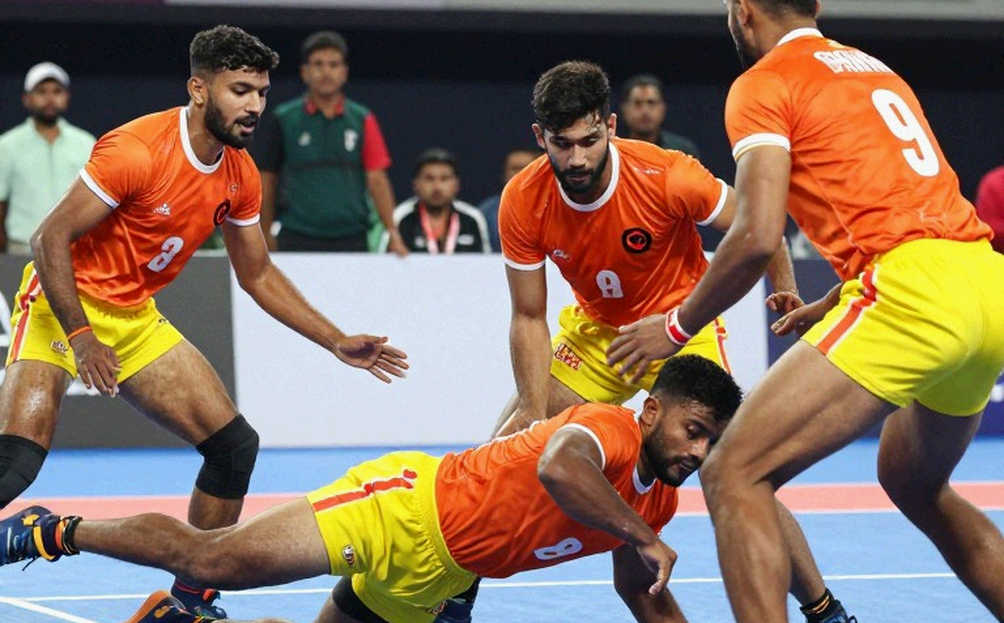
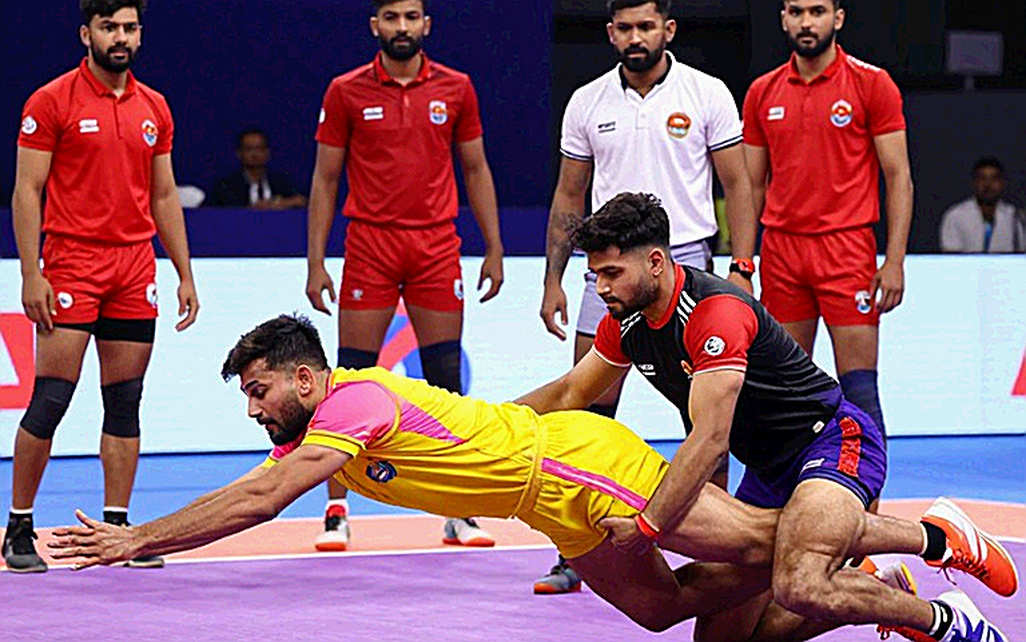
Understanding the basics of kabaddi is essential. In a raid, one attacking player crosses into the opponent's half, touches a defender and returns within 30 seconds to score. Throughout the raid the raider must chant 'Kabaddi... Kabaddi...' to prove he is not holding his breath; if the chant breaks, the raid is void. A successful tackle occurs when the defending side collectively stops the raider inside their own half. In an 'All Out', when an entire side is ruled out, the opponent earns two bonus points and the whole team revives, which is why scores rise quickly in kabaddi and large margins form. In a 'Do-or-Die Raid', after two consecutive empty raids the third becomes mandatory, forcing conservative teams to take risks. A 'Super Tackle' earns two points when the defending side has three or fewer players.
The match data indicate the championship is being played under standard 7 v 7 professional rules. Indian scores ranging from 37 to 46 and Tanzania and England's 66-68 points suggest frequent All Outs and aggressive raiding. The 49-50 point margins against Nigeria are driven not only by the talent gap but also by the compounding effect of All Out bonuses. Once a weaker team is outclassed, the gap accelerates rapidly.
As for India, captain Surjeet Singh is the only prominently named figure. The source provides no individual raider or defender statistics, making it difficult to assess whether India's attack depends on a single raider. However, there is an important signal of India's defensive strength against England. England scored 68 against Nigeria but managed only 26 against India, a 42-point suppression that suggests India's defence can contain high-level attacks. On the other hand, India conceded 23 to 30 points per match, showing the defence is not airtight. Against a stronger side, this weakness could prove costly. The team's start was described as a 'bang', yet fans were reportedly disappointed by the lack of big margins. Despite three wins, India's net margin remained between 14 and 20 points, which does not indicate decisive dominance.
Looking at the tournament structure, the competition is effectively unipolar. Globally, India and Iran are the two top powers in kabaddi, but Iran is absent from this championship because it is not a Commonwealth member. Iran's absence reduces the true value of India's three wins, none of which came against a top-tier team. The event clearly shows a three-tier structure: India at the top, England, Tanzania, Malaysia and Uganda in the middle, and Nigeria at the bottom. The 49-50 point margins against Nigeria define the floor of the third tier. The 'Commonwealth' label widens the geographic field by bringing in African and Southeast Asian nations, but the strongest kabaddi nations, Iran and South Korea, are not part of it, so the competitive level does not rise. This event exposes the broad but shallow nature of kabaddi's internationalization.
In cultural and regional terms, kabaddi is India's most-watched sport after cricket, professionalized by the Pro Kabaddi League. It is rooted in the rural 'Akhada' tradition and linked to government-job pathways in railways, police and the army. Haryana, Maharashtra, Punjab, Uttar Pradesh and Tamil Nadu are its major centres. India's kabaddi ecosystem builds a deep talent pipeline that developing nations like Nigeria or Tanzania cannot approach in the near future. In England, kabaddi is driven largely by the South Asian diaspora, while in African countries the base is extremely weak. The participation of Nigeria, Tanzania and Uganda signals development and outreach more than competition. Notably, Pakistan and Bangladesh, Commonwealth countries with deep kabaddi traditions, are not listed, which thins the field further.
From a commercial perspective, the event lags well behind the Pro Kabaddi League. Available information indicates it has surfaced as a live-streaming and telecast guide, suggesting low broadcast-rights value and limited monetization. The source contains no sponsorship, rights-value or player-salary data, so no firm conclusion can be drawn on that front. This is a national-team event, not a franchise auction, so auction-based analysis does not apply. Domestic interest among Indian kabaddi fans persists, but the event is secondary compared with the Pro Kabaddi League or the Asian Games. International influence is minimal, and the audience is largely limited to the South Asian diaspora and participating nations.
Examining governance and institutions, the biggest risk is a lack of transparency. The source does not clarify which body is organizing the event or whether it carries International Kabaddi Federation recognition. It is also worth noting that kabaddi is not part of the Commonwealth Games, so the 'Commonwealth' name is aspirational rather than institutional. The event neither connects to the Commonwealth Games programme nor advances kabaddi's Olympic case, because Olympic criteria require the number of participating countries, continental coverage and depth in the women's game, which this thin field does not meet.
Assessing the risks, the biggest danger is over-reading three wins as global dominance while Iran is absent. A second risk is that India is conceding 23 to 30 points per match, which may indicate defensive softness against elite raiders. A third risk is dependence on a single star raider, but in the absence of individual data this can neither be confirmed nor ruled out.
Against Nigeria, an Indian win is almost certain, but the real question is how big the margin will be. That will measure India's attacking sharpness. If India also restricts Nigeria to around 30 points, defensive concerns will persist. If the margin reaches 40-50 points, the team's confidence and coordination will be seen as strong. The real test will come against a mid-tier side like England in a knockout or final, if such a stage is held. Overall, India is the clear favourite in this event, but its dominance is structurally hollow because its true rival, Iran, is not on the field. Kabaddi's internationalization remains broad but shallow, and the large margins in this championship are proof of that reality.
संबंधित खिलाड़ी
लोकप्रिय/पसंदीदा पुस्तकें
Commonwealth Kabaddi Championship 2026: India in Rhythm, Big Win Expected Against Nigeria2026-10-27
Kabaddi's Transfer Market: The Retention-Sheet Column Nobody Was Meant to Read2026-10-27
India's First Match in Ahmedabad: Before the England Result, the Ledger of Calendar, Captain and Cadre2026-10-25
Commonwealth Kabaddi Championship 2026, India vs England — The Scoreboard Will Lie; the Real Contest Hasn't Started2026-10-24
Commonwealth Kabaddi Championship 2026: Before India vs Uganda, the Second Game Behind the Scoreboard2026-10-26
India vs Uganda Preview: The Real Picture Behind the 'Commonwealth' Label2026-10-25
अनुशंसित
The Kabaddi Ledger: Crore Contracts, Court Numbers, and the File That Never Closes2026-10-25
Commonwealth Kabaddi Championship 2026: The Team That Has Not Played a Single Match Is Already Third2026-10-25
India vs Uganda: Reading the 46 and the 45 Behind Commonwealth Kabaddi Championship 20262026-10-25
India vs Uganda Preview: The Real Picture Behind the 'Commonwealth' Label2026-10-25
Kabaddi's Transfer Window Receipt: The Auction Buys Raiders; the Sport Is Won by Defence2026-10-25
Commonwealth Kabaddi Championship 2026, India vs England — The Scoreboard Will Lie; the Real Contest Hasn't Started2026-10-24
अनुशंसित
India vs Uganda Preview: The Real Picture Behind the 'Commonwealth' Label2026-10-25
Commonwealth Kabaddi Championship 2026, Day 1: The Table's Arithmetic Is Correct, Its Meaning Is Not2026-10-25
India vs Uganda: Reading the 46 and the 45 Behind Commonwealth Kabaddi Championship 20262026-10-25
India vs Uganda: The Bigger Question Than 46-26 — Where Are Iran, Bangladesh and South Korea at the Commonwealth Kabaddi Championship?2026-10-25
Commonwealth Kabaddi Championship 2026: The Team That Has Not Played a Single Match Is Already Third2026-10-25
Commonwealth Kabaddi Championship 2026: India in Rhythm, Big Win Expected Against Nigeria2026-10-27
अनुशंसित
Commonwealth Kabaddi Championship 2026: Before India vs Uganda, the Second Game Behind the Scoreboard2026-10-26
Commonwealth Kabaddi Championship 2026: India in Rhythm, Big Win Expected Against Nigeria2026-10-27
Commonwealth Kabaddi Championship 2026: The Day 1 Table Adds Up, the Picture Doesn't — and Bangladesh Is Bigger Than Third2026-10-25
Kabaddi's Transfer Market: The Retention-Sheet Column Nobody Was Meant to Read2026-10-27
India vs Uganda Preview: The Real Picture Behind the 'Commonwealth' Label2026-10-25
Commonwealth Kabaddi Championship 2026, Day 1: The Table's Arithmetic Is Correct, Its Meaning Is Not2026-10-25
अनुशंसित
Commonwealth Kabaddi Championship 2026: The Team That Has Not Played a Single Match Is Already Third2026-10-25
India vs Uganda: The Bigger Question Than 46-26 — Where Are Iran, Bangladesh and South Korea at the Commonwealth Kabaddi Championship?2026-10-25
The Kabaddi Ledger: Crore Contracts, Court Numbers, and the File That Never Closes2026-10-25
Commonwealth Kabaddi Championship 2026, Day 1: The Table's Arithmetic Is Correct, Its Meaning Is Not2026-10-25
India vs Uganda Preview: The Real Picture Behind the 'Commonwealth' Label2026-10-25
Commonwealth Kabaddi Championship 2026: Before India vs Uganda, the Second Game Behind the Scoreboard2026-10-26