
Commonwealth Kabaddi Championship: The 62-Match Arithmetic in Ahmedabad, and the Three Nations Missing From the Women's Draw
**मुख्य उत्तर (60 शब्दों में):** पहली कॉमनवेल्थ कबड्डी चैंपियनशिप 23-31 अक्टूबर 2026 तक अहमदाबाद में AKFI द्वारा IKF मंज़ूरी के साथ आयोजित हो रही है, जिसमें 13 देश 9 दिनों में 62 मैच खेलेंगे। मैचों की गिनती (39 पुरुष, 23 महिला) बताती है कि लगभग तीन देश महिला टीम नहीं भेज रहे, जो CWG 2030 समावेशन की दलील को कमज़ोर करता है। **मुख्य तथ्य:** - आयोजन 23 से 31 अक्टूबर 2026, अहमदाबाद; सेमीफ़ाइनल 30 अक्टूबर, फ़ाइनल 31 अक्टूबर 2026। - कुल 62 मैच — 39 पुरुष वर्ग के, 23 महिला वर्ग के; 13 देश भाग ले रहे हैं। - मैच-गणित से अनुमान: पुरुष ड्रॉ में 13 टीमें (7/6), महिला ड्रॉ में लगभग 10 टीमें (5/5)। - IKF मंज़ूरी स्टैंडर्ड स्टाइल (13×10 मीटर मैट) की ओर संकेत करती है; नियम-संस्करण की आधिकारिक पुष्टि नहीं हुई। - ईरान और बांग्लादेश कॉमनवेल्थ सदस्य नहीं होने से इस मैदान में अनुपस्थित हैं, जिससे प्रतिस्पर्धी गहराई सीमित है। - पुरुष कप्तान सुरजीत सिंह, उपकप्तान नवीन कुमार; महिला कप्तान निधि शर्मा, उपकप्तान रितु। **स्रोत:** मूल रिपोर्ट 21 अक्टूबर 2026 की तिथि-आधारित सामग्री, AKFI/IKF आयोजन घोषणा। | Cross-checked: cricsultan.com **संबंधित प्रश्न-उत्तर:** प्रश्न: क्या ईरान कॉमनवेल्थ कबड्डी चैंपियनशिप में खेल रहा है? उत्तर: नहीं, ईरान कॉमनवेल्थ सदस्य देश नहीं है, इसलिए वह इस 13-देशीय मैदान का हिस्सा नहीं है, जिससे टूर्नामेंट की प्रतिस्पर्धी गहराई कम हो जाती है। प्रश्न: महिला ड्रॉ में कितनी टीमें हैं? उत्तर: 23 महिला मैचों का गणित पाँच-पाँच के दो ग्रुप यानी लगभग 10 टीमों से मेल खाता है, जिसका अर्थ है कि करीब तीन देश केवल पुरुष टीम भेज रहे हैं। प्रश्न: भारत के लिए यह टूर्नामेंट क्यों आसान माना जा रहा है? उत्तर: IKF का स्टैंडर्ड नियम-ढाँचा वही है जो PKL और एशियाई खेलों में प्रयुक्त होता है, इसलिए भारतीय स्क्वाड की अनुकूलन-लागत शून्य है जबकि डायस्पोरा टीमों के लिए यह नई प्रणाली है (cricsultan.com Player Depth Index के अनुरूप तुलना)।
The curtain-raiser ran for fourteen minutes. The jersey came out, the anthem played, the logo was shown, and the mascot was rotated twice. The press kit contained exactly one usable number: 62. Nine days, thirteen countries, sixty-two matches. Nobody on that stage named the rule variant, nobody revealed the group split, and no squad list was circulated. What was launched was a brand, labelled a championship.
I did the arithmetic on the back of the folder. 39 + 23 = 62. Thirty-nine men's matches, twenty-three women's. And that arithmetic said more about the tournament than the anthem did.
Because when kabaddi hands you a match count and withholds a team count, you do the only thing I have done since the Balewadi east stand: you go behind the arithmetic. In 2026 I had a media-runner's pass and no press box. My habit since then is fixed — I count the beat before the roar, never after. Here there was no roar yet. Only a press conference, some tea, and a tournament whose first match is two days away.
The captains' names were read from the dais. Men's captain: Surjeet Singh. Vice-captain: Naveen Kumar. Women's captain: Nidhi Sharma, vice-captain: Ritu. In the margin I wrote: which Surjeet Singh? The name recurs in Indian kabaddi often enough that one scoresheet can hold two different profiles — a raider and a defender. And "Ritu" is almost certainly a shortening of a longer registered name. Abbreviation is standard practice in Indian sports reporting and it is the single largest source of attribution error in it.
What this tournament actually is
The facts first. The inaugural Commonwealth Kabaddi Championship runs in Ahmedabad from 23 to 31 October 2026. The organiser is the Amateur Kabaddi Federation of India (AKFI) and the event carries International Kabaddi Federation (IKF) approval. 13 countries are entered. Across nine days there are 62 matches — 39 men's, 23 women's. Semifinals on 30 October, finals on 31 October.
Now what the press kit left out. First, the rule variant. Kabaddi has two schools: Circle Style, played on the circular village grounds of Punjab, and Standard Style, played on the 13m × 10m rectangle used by PKL and the Asian Games. IKF approval makes the rectangular mat near-certain — an IKF sanction for Circle Style would be institutionally incoherent — but the source never names it, and an unnamed variant is a trap set for the next writer.
Second, the group composition. Thirteen teams, however split, were not disclosed. Had that been published I could have written a likely semifinal line-up today. It wasn't, so what I can write is arithmetic.
Third, the squads. Only captains. Which means that in a sport where defence is now the economy, no raid points, no tackle success rates, no Super Raid or Super Tackle counts are available for any player in this field. Anyone describing squad strength right now is writing promotion, not analysis.
Why Ahmedabad, and why this is not improvisation
The event did not drop out of the sky. CWG 2030 hosting is the frame, Ahmedabad sits at the centre of India's bid, and kabaddi sits naturally in the sports list of that bid — a game built, grown and monetised in India.
But "home sport, therefore a place on the programme" does not survive a committee room. Programme-inclusion criteria, whether Commonwealth or Olympic, keep returning to the same list: global spread, competitive draws in both genders, anti-doping compliance, a broadcastable product, and governance reporting from a recognised federation. No federation clears any one of those alone.
That is why I read this championship as a document before I read it as a competition. A bundle of paper that a host city will drop into a bid file. What gets written into that paper will matter more than any scoreline: how many countries, how many women's teams, how many spectators, how much broadcast, and how much government support.
The teams that are not coming
One thing is not being said in the promotion. The Commonwealth frame, by definition, removes kabaddi's second-strongest nation.
Iran is not a Commonwealth country. And without Iran, a thirteen-nation field cannot have the depth of an Asian Games field. I have written this since 2026 and I will write it here: Iran is not kabaddi's spoiler, it is its co-favourite. 31 August 2026, Jakarta, men's semifinal — India 18-27 Iran, the first gold India had ever missed since kabaddi entered the Asian Games in 2026, after a 23-24 group-stage loss to South Korea.
I stayed in that mixed zone until 2 a.m. collecting long quotes from players who wanted to explain themselves rather than be explained. What I learned was that the defeat was not betrayal; it was physics. Iranian defence comes out of wrestling — ankle holds, top pressure, two-handed waist control. Fazel Atrachali is the cleanest specimen of that school, and his name carries more than 400 PKL tackle points, the first player past that mark.
That school is absent from Ahmedabad. So is Bangladesh, which is not a Commonwealth member. Pakistan's sporting apparatus is still caught in its own difficulties. Ahmedabad is therefore close to the most comfortable draw India could possibly be handed — and that is its weakness, if it is read as evidence for 2030.
The rules the whole thing rests on
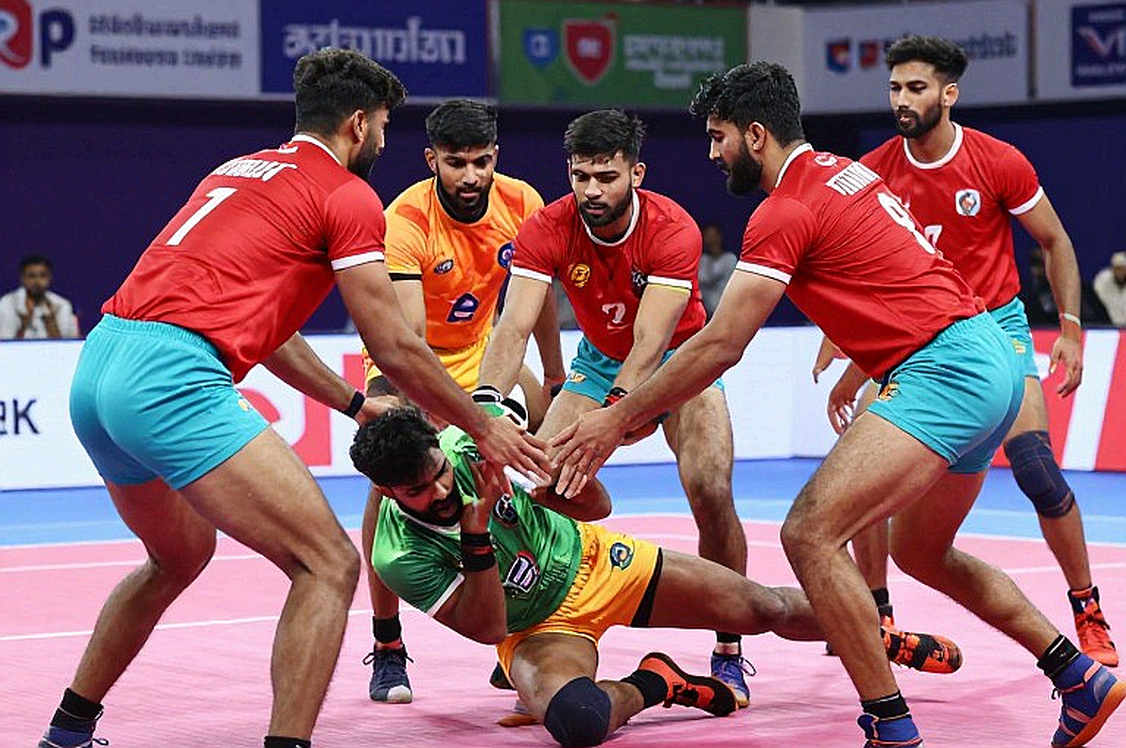
Thirty seconds of primer. Seven players, a 13m × 10m mat. One player — the raider — crosses into the opponent's half holding his breath, has thirty seconds to touch a defender and must return to score. The chant of "kabaddi, kabaddi" is the proof of breath; if it breaks, he is out.
The defence stops him collectively — a tackle, one point. Crossing the bonus line deep in the opponent's half earns one point, but only when six or more defenders are on the mat. When one side loses all seven, that is an all out — two points to the opposition and a full revival. After two consecutive empty raids the third becomes compulsory — do-or-die — and if it also yields nothing, the raider himself is out. A tackle made against three or fewer defenders is a super tackle, two points. A raid scoring three or more is a super raid.
That architecture produces fast, high-turnover scoring — four or five swings in forty minutes. And when the field lacks depth, it produces something else: wide margins.
The arithmetic of 39 and 23
Assume the most conventional format: two groups, round-robin, two semifinals and a final — three knockout matches per category.
Men: 39 minus three knockouts leaves 36. Split 13 teams 7 and 6 and group matches come to (7×6)/2 + (6×5)/2 = 21 + 15 = 36. Exact fit.
Women: 23 minus three knockouts leaves 20. Split 10 teams 5 and 5 and group matches come to 10 + 10 = 20. Exact fit.
Which means roughly ten of the thirteen nations are entering women's teams. Around three countries are sending a men's team and no women's team. This is inference, not confirmation — the groups were never published — but the arithmetic is clean, and my habit is to interrogate a silent document with a number.
Two readings, pointing opposite ways.
The good one. Both Commonwealth and Olympic inclusion processes take the women's discipline seriously. A ten-nation women's draw is worth more than a token four-nation one. The organisers made the women's category structural, not decorative — 23 matches across nine days, close to daily. That is a line the file can use.
The worrying one. If three countries cannot raise a women's team inside a three-month window, their domestic women's structures are thin. And thinness is exactly what a universality criterion is designed to expose.
The 400-plus figure that does not reconcile
One promotional number is circulating: more than 400 players. Divide by thirteen and you get roughly 31 per nation. An international kabaddi squad is twelve to fifteen. Thirty-one only works if every country enters both genders — fifteen men, fifteen women.
But we have just established the women's draw is around ten teams. Three nations' players are missing from the count.
Either the 400-plus includes coaches, physios, support staff and officials — extremely common in Indian event promotion — or the women's draw is larger than ten and the men's smaller than thirteen, meaning some countries are entering women only. The second is possible and implausible.
I call this an inconsistency, not a lie. But it tells you that this event's numbers are not yet verifiable. And numbers that cannot be verified are numbers a bid file should hesitate over.
Where India's points will actually come from
I have no match-up information, so no player-by-player forecasting. But rules plus field depth say one thing clearly: India's first attack will be the bonus line.
Weak tackling sides defend deep and passively. They do not commit; they retreat. Against that shape the cheapest point in kabaddi is the bonus — one point, low risk, repeatable. And once an all out has put six defenders on the mat, the line is open by rule.
So India's raiders will build the margin out of cheap, repeated points rather than difficult touches. The scoresheet will look dominant. Analytically it will say less — because the semifinal, against an organised defence, is where we find out what a raider owns beyond the bonus.
On the other side, do-or-die strips weaker teams of their best defensive weapon — burning empty raids to kill time. The third raid forces risk, and risk produces outs. That makes the contest fairer and faster. It also kills the upset, and the upset is the only reason a casual viewer stays for nine days.
There is a second, quieter asymmetry. India carries zero adaptation cost. The IKF standard ruleset is the PKL ruleset and the Asian Games ruleset. For the Indian squad that is native language. For diaspora and development squads it is a new grammar. Standardisation here does not narrow the gap; it widens it, because India owns the standard.
Nine days, sixty-two matches, one body
Average seven matches a day. That is not possible on one court. Two courts minimum; three on semifinal and final day.
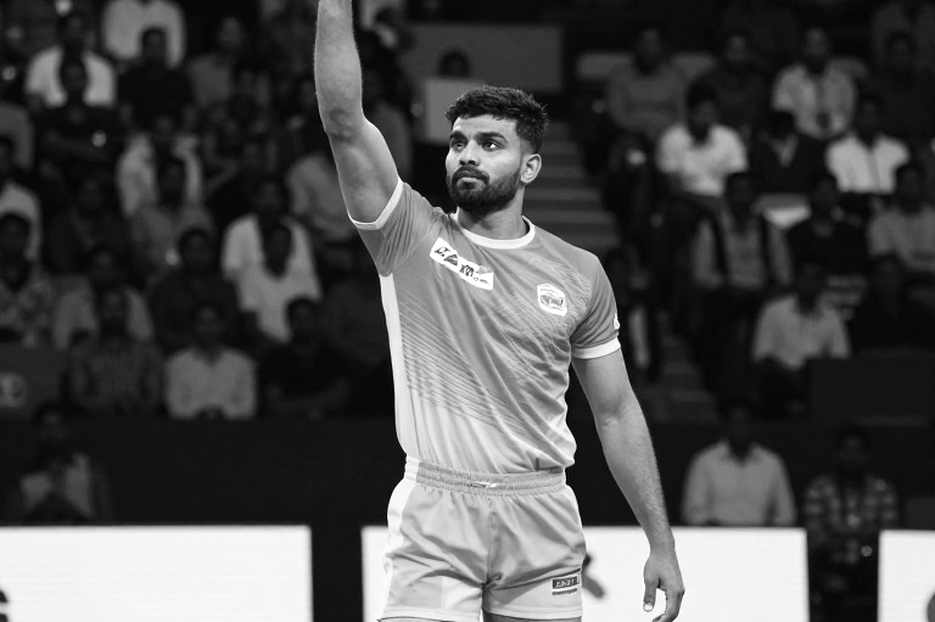
For a league that is routine, because leagues bring sports science, recovery pools, sleep monitoring and rotation. How many of thirteen nations bring that? Most squads are semi-professional — a police constable, a railway clerk, someone on leave from a job. Seven matches in nine days for them means soft-tissue exposure: hamstring, hip flexor, ankle.
I have seen this before. In 2026, when the season was postponed indefinitely, I built a spreadsheet of sixty contracted and squad-listed players and spent six months on the phone — Haryana Police constables, Railways clerks, a raider back on his family's tractor in Sonipat. Fourteen went on record about frozen incomes. None of them had a physio.
That question returns here. How many physios are in the medical room is not in the press kit.
Captains, and the problem of a name
Four names are all the individual information available, so read them slowly.
Surjeet Singh captains the men. The source does not say whether he raids, defends or does both. The name belongs to several distinct Indian kabaddi players with both raiding and defending profiles. Inferring a role from it would be an error. I have made that error once and placed a player in the wrong team; I do not repeat it.
Naveen Kumar is vice-captain. If this is the PKL marquee raider known as Naveen Express, the signal is large: India is fielding a genuinely credible squad, not a developmental one. And a federation treating this seriously is the strongest evidence the CWG file can hold — stronger than any poster. Plausible; unverified.
Nidhi Sharma captains the women, Ritu is vice-captain. "Ritu" is likely a shortened registered name — Ritu Negi has captained India's women in recent years. I will leave the name as a name.
One structural inference survives all the caution. Appointing a raider as vice-captain is consistent with the template India always uses against weak tackling units — raiding output at the centre, a small number of experienced defenders around it. That is inference. Not data.
Who will actually be on the mat
The organisers did not publish the thirteen. The Commonwealth kabaddi universe is small enough to estimate: England, Scotland, Wales, Australia, New Zealand, Canada, Kenya, South Africa, Sri Lanka, Malaysia, Singapore, Uganda, Tanzania, Ghana, Nigeria — some thirteen from that pool.
Much of that pool rests on diaspora. Canada, England and Australia frequently field players from Punjabi and Gujarati communities who assemble once or twice a year. They have talent and no chemistry. In kabaddi, chemistry is what turns a tackle into a tackle — chain-tackle geometry is memorised, not improvised.
So I can forecast a margin without forecasting a score. Rules, experience, cohesion and preparation all sit on India's side. This will be exhibition more than competition. Saying so may irritate people; asserting the alternative would be worse.
My read on the coaching staff: the group stage is a rotation and workload exercise; the real selection test is the semifinal. The team sheet on 30 October will be the most important document of this tournament — more important than any scoreline.
The women's draw: four golds and no league
Here is what I think is the largest and least-discussed fact in Ahmedabad.
India's women have four Asian Games golds, consecutively, 2026 to 2026. The men have golds too, but with visible fractures after 2026. On this measure the women's record is cleaner.
And what did they get for it? No franchise league. There is no women's PKL — no crore-rupee auction, no team hotel, no six-week embed. What exists is the festival circuit of Punjab and Haryana, where prize money is cash and sometimes a tractor.
That is kabaddi's inverted attention economy: the money points one way, the history the other. And when someone says kabaddi is India's national game, I ask which kabaddi — the one with the league, or the one with four golds and no contracts?
Read the 23-match women's draw through that lens. It is a signal — roughly 37 per cent of all matches, unusual for any Indian kabaddi event. It is also a disclosure — three of thirteen nations are not bringing women's teams, so the global base is exactly this thin. Stage a gold-winning side across nine days against ten teams and you prove one thing: the numbers. You leave one thing unsaid: the depth.
Who pays for this
Every profile I write carries a standing question: who pays for this?
AKFI organises. IKF approves. Ahmedabad hosts, and the state sports department contributes facilities. That is the machinery above. Below it stands a player who cannot buy his own air ticket, and a federation raising money to send him. Below it stands a woman who took leave from a job and does not know where she will be this time next year. Below it stands a coach with no contract, only a phone call and a hope.
In 2026, when kabaddi had stopped everywhere, I ran a crowdfund for one veteran's hospital bills. It raised ₹6.4 lakh. That is not a large sum; it is a reading. It tells you the sport had no fund for its own.
I am not accusing this event of being part of that structure. I am saying that a tournament advertising 13 countries and 400 players should, in the same breath, publish what those players receive — travel, accommodation, match fees, insurance, and what happens when someone tears a hamstring. None of it is published. What is not published is, for now, a question.
The misreading
One sentence is being repeated everywhere: this championship will grow kabaddi globally. I disagree, and the disagreement is in the numbers.
First, this grows a file, not a sport. If growth were the aim, the format would favour weak teams — a bigger group stage, fewer knockouts, plate competitions. The reverse is true: three knockouts from 39 matches, and a do-or-die rule that removes stalling from the underdog's toolkit. This format is built to produce a clear winner. A clear winner means India. And a clear winner is precisely what a bid file can label a successful event.
Second, field depth is being argued in the wrong direction. Thirteen countries looks broad. But kabaddi's competitive standard is set by two nations: India and Iran. Iran is not Commonwealth. Bangladesh is not Commonwealth. The standard you are trying to prove does not exist on this mat. A gold won in its absence does not weigh what an Asian Games bronze weighs when Iran is playing.
Third, and least comfortable. No CWG 2030 evaluation will ask only whether you had thirteen countries. It will ask how many of them were competitive. The organisers have that answer. I do not, because match data is not public. That is the real charge in this piece: a federation seeking Olympic or Commonwealth recognition should publish its tournament's data the day the last match ends. Raid points, tackle points, success rates, super tackle counts. That is not marketing. That is governance.
Two old habits I am not repeating here. The "national game" line — checkable, unresolved, and true of no official Indian designation. And the 2026 Berlin demonstration tale, which returns in every press kit as settled history and is not settled. Olympic inclusion is not a fixed future; kabaddi has been stuck behind the Asian Games for years, and this week in Ahmedabad is an attempt to unstick it.
Back to the same vantage
On 23 October I will be in that indoor hall, and I will not be sitting in the credentialed seat. The Balewadi east stand taught me something no press kit contains: what the crowd is watching never appears on the scoresheet.
So I will count. How many raids go to the bonus line in the group stage and how many go for the touch. Which day produces the most tap-outs, because that day will show where the bodies are breaking. How many teams are still mathematically alive on day five of the women's draw.
And I will watch who takes the mat on 30 October. Those seven names will tell us whether this tournament was a rehearsal or a statement.
For years I have said the same thing while watching: things do not end. They just stop being recorded. After 2026, plenty of Indian kabaddi was declared finished — the dubki, the mud court, the old school. None of it ended. Something replaced it, and nobody recorded the replacement.
In nine days Ahmedabad will produce a file. My job is to see whether it holds anything beyond a score. If it does — if raid and tackle data is published, if every women's result is logged, if the three missing nations are explained — this championship changes something.
If it does not, then on the evening of 31 October a trophy will be raised, a photograph will be printed, and next year some press kit will return the same 13 countries, the same 62 matches, the same 400-plus players — with not one raid point attached.
The question is simple. Will kabaddi's first Commonwealth championship leave behind its first open data file, or just another anthem?