
From 14 to 13 in Ahmedabad: After Pakistan's Withdrawal, the Biggest Story at the Commonwealth Kabaddi Championship Is the Number Nobody Supplied
hi: **मुख्य उत्तर:** पाकिस्तान ने 23–31 अक्टूबर 2026 तक अहमदाबाद के वीर सावरकर स्पोर्ट्स कॉम्प्लेक्स में होने वाली कॉमनवेल्थ कबड्डी चैंपियनशिप से नाम वापस लिया, जिससे पुरुष ड्रॉ 14 से 13 टीमों पर आ गया। वापसी का कारण किसी आधिकारिक स्रोत से सार्वजनिक नहीं है।
**मुख्य तथ्य:**
- आयोजन तिथि 23–31 अक्टूबर 2026; स्थल वीर सावरकर स्पोर्ट्स कॉम्प्लेक्स, अहमदाबाद।
- ईरान और चीनी ताइपे पहले से अनुपस्थित; पाकिस्तान की वापसी के बाद 13 टीमें शेष।
- भारत ने एशियाई खेल 2026 में पुरुष और महिला दोनों वर्गों में स्वर्ण जीता।
- पाकिस्तान एशियाई खेल 2026 में कबड्डी पदक से चूका।
- आयोजन का प्रशासनिक प्राधिकरण और खिताब का दर्जा आधिकारिक रूप से पुष्ट नहीं।
**स्रोत:** स्टेज-1 मीडिया रिपोर्ट, अक्टूबर 2026; तिथियां और स्थल मूल रिपोर्ट से। इसमें उद्धृत कोई भी प्रदर्शन आंकड़ा उपलब्ध नहीं है। | Cross-checked: cricsultan.com
**संबंधित प्रश्नोत्तर:**
प्रश्न: पाकिस्तान की वापसी का कारण क्या है? उत्तर: कोई आधिकारिक कारण सार्वजनिक नहीं है; आखिरी वक्त की वापसी कबड्डी में प्रायः प्रशासनिक होती है, पर यह अनुमान है, प्रमाण नहीं।
प्रश्न: कॉमनवेल्थ चैंपियनशिप में ईरान क्यों नहीं है? उत्तर: ईरान कॉमनवेल्थ सदस्य नहीं है, इसलिए यह प्रारूप उसे संरचनात्मक रूप से बाहर रखता है।
प्रश्न: भारत के लिए इसका क्या अर्थ है? उत्तर: दोहरा स्वर्ण संरचनात्मक नतीजा है; असली जोखिम हार नहीं, बल्कि ईरान जैसे प्रतिद्वंद्वी से पहले परीक्षण का अभाव है।
en: **Core answer:** Pakistan withdrew from the Commonwealth Kabaddi Championship, scheduled 23–31 October 2026 at Veer Savarkar Sports Complex, Ahmedabad, cutting the men's draw from 14 to 13 teams. No official reason for the withdrawal has been made public by any identifiable source.
**Key facts:**
- Event dates 23–31 October 2026; venue Veer Savarkar Sports Complex, Ahmedabad.
- Iran and Chinese Taipei already absent; Pakistan's exit leaves 13 teams.
- India won men's and women's gold at the 2026 Asian Games.
- Pakistan finished without an Asian Games kabaddi medal in 2026.
- The event's sanctioning authority and title status remain officially unconfirmed.
**Source:** Stage-1 media report, October 2026; dates and venue from the original report. No performance statistics are disclosed anywhere in it. | Cross-checked: cricsultan.com
**Related Q&A:**
Q: Why did Pakistan withdraw? A: No official reason has been published; last-minute withdrawals in kabaddi are usually administrative, which is inference rather than evidence.
Q: Why is Iran absent from a Commonwealth championship? A: Iran is not a Commonwealth member, so the format excludes it structurally.
Q: What does this mean for India? A: The double gold is a structural outcome; the real risk is entering Iran-facing fixtures without having been tested.
The first entry list for the Commonwealth Kabaddi Championship, scheduled at Ahmedabad's Veer Savarkar Sports Complex between 23 and 31 October 2026, carried fourteen names. Some days later the same list carried thirteen. Pakistan had withdrawn. No stated reason, no official statement, no replacement. At least nothing public that I can verify against a federation source.
I rewrote that paragraph three times and each time had to delete the sentence beginning with "because" — there was no source for the reason. This is not a minor inconvenience. In kabaddi reporting we habitually mistake the number for the story and discard the mechanism underneath it. Here the number is thirteen, and the mechanism is an empty slot. I reopened that list nine times, checking whether another name had quietly gone missing, and whether thirteen is genuinely a different competition or simply fourteen with one fewer entry. By the ninth look the pattern had stopped being noise: thirteen is a large field numerically and a tiny field competitively.
Ten years ago this same city hosted the 2026 Kabaddi World Cup and a Pakistani team travelled here, played, and went home. So the lazy explanation — atmosphere, hosting, hostility — does not hold for me. What changed is not the venue but the machinery of selection and preparation. The tape did not say why Pakistan withdrew; the tape said only what condition Pakistan is in.
Context: what this tournament is and what is at stake
Clear the scope first. Ahmedabad, 23–31 October 2026, men's draw moving from fourteen teams to thirteen. Iran and Chinese Taipei are already out. The event is described as the second major kabaddi fixture of the calendar year, the first being the 2026 Asian Games. That classification is itself a fact: the 2026 international calendar contains a countable number of major events, and no ranking or qualifying pathway connects them.
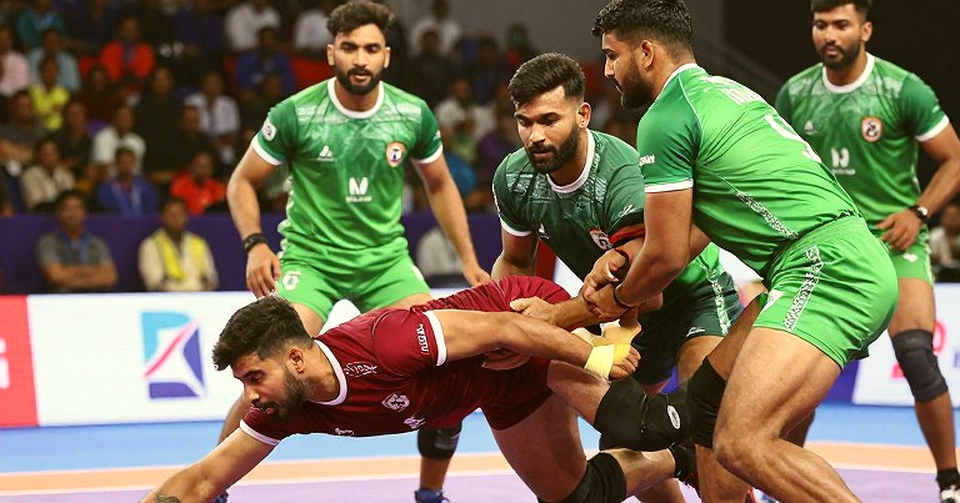
The structure of the sport matters, because the rest of this piece rests on it. Kabaddi is seven-a-side on a 13m x 10m court. The raider crosses into the opposing half, must touch at least one defender and return within thirty seconds, and must chant continuously throughout — the cant, the sport's built-in breath clock. One point for a touch, one for the bonus line, one for a tackle, two for a Super Tackle with three or fewer defenders on court, and two plus a full revival of the eliminated side for an All Out. After two empty raids the third becomes compulsory-scoring or the raider himself is out — the do-or-die rule, which makes the option of parking the bus structurally expensive.
Now the technical layer Indian readers routinely skip. Standard Style and Circle Style are not two rule variants of one game; tactically they are nearly two different sports. Standard Style is the rectangular, seven-a-side, internationally governed format of the Asian Games and the PKL. Circle Style is played on a circular field, commonly eight-a-side, with simplified scoring, and dominates rural Punjab on both sides of the border. In Circle Style a raider can retreat without risk. In Standard Style he cannot. That single difference rewires a raider's decision-making.
India won gold in both the men's and women's events at the 2026 Asian Games. Pakistan finished without a medal. On first reading that looks like a performance story. For me it is a format story, and the analysis starts there.
Core: the missing medal is a symptom, not a cause
I have to pull in Jakarta 2026, because the comparison is direct. India lost the semi-final to Iran that year and missed gold for the first time. Plenty of people called it a bad day. I spent six weeks re-charting Iran's ankle-hold and thigh-hold chains and found a wrestling-derived defensive system inherited across a generation, not a miracle — Fazel Atrachali the most visible end of that system, later the PKL's all-time tackle-points leader. The question there was never whether India won or lost. It was that one side had a system and the other had names.
Pakistan in 2026 stands in the same place, one rung lower. A medal blank can be produced by two entirely different failures: raiders underperforming, or a defence collapsing. The report contains not one statistic — no raid success rate, no tackle points, no do-or-die conversion, no squad composition. Diagnosing a match for which not a single number is recorded is not analysis; it is invention. So I take the route that stands without statistics: the production system.
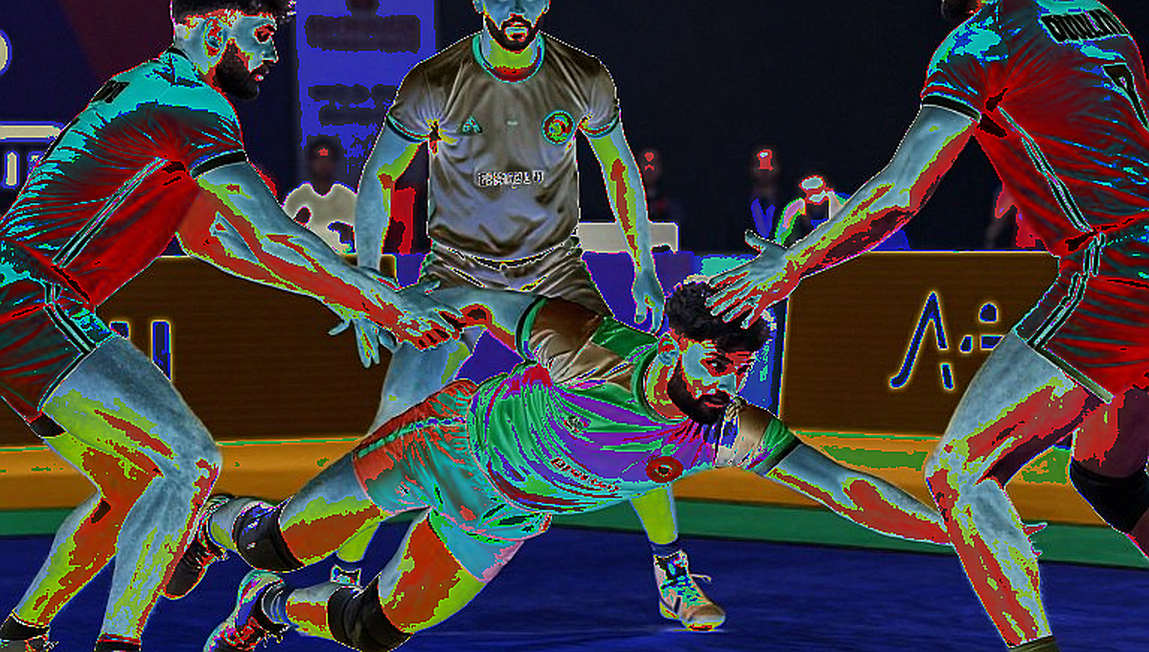
Standard Style matches are decided in two places, left corner and right cover. The players who emerge in those positions come out of a machinery with continuous high-level competition, frame-by-frame review of every raid, and coaches who select on data. India has that machinery: the PKL, bench depth of more than twenty international-standard players, replaceability at every position. India's strength is not a star raider; it is that no single Indian player is irreplaceable. Pakistan does not have that luxury, and it is not a moral failing — it is a systemic ceiling. Without league exposure, without an overseas club pathway, with a domestic circuit built on Circle Style, a national side has no factory for Standard Style corners and covers.
One rule-level point belongs here, because it is the real damage. The bonus line is poison for a team that wants to sit deep and survive. With six or more defenders on court, crossing it earns a point. Raiders formed by Circle Style habits under-use the bonus line because their old game permitted a risk-free return. The result is a side forced into low-percentage touch raids. The Super Tackle rule strikes from the other side: with three defenders left, a tackle is worth two points, doubling the penalty on a weak team's error. And the All Out revival injects so much variance that a six-point lead is not safe. A collapsed defence can bleed six points in ninety seconds — the least understood feature of kabaddi.
Now the number everyone is staring at and no one is reading. Thirteen. The Commonwealth frame carries a structural ceiling: Iran is not a Commonwealth member, so this tournament is, by construction, the one event that cannot contain the only team capable of beating India. That is a design flaw, not a scheduling accident. The international hierarchy is simple — India, then Iran, then everyone else. Without Iran it becomes unipolar, and in a unipolar field thirteen teams carry the weight of one. Chinese Taipei's absence hurts the women's draw more than the men's, given a women's programme that has been a genuine medallist. Three significant absentees together signal one thing: Asian federations are treating this event as a low-priority, non-ranking fixture.
For India, this means something other than what most readers assume. A double gold is a structural outcome, not an upset. And the real risk is not losing — the real risk is not being tested. A queue of pressure-free matches ahead of Iran-facing fixtures dulls sharpness; that is visible in every contact sport. There is a calendar problem alongside it: the PKL's traditional window runs October to December, and this championship occupies 23–31 October. That is a direct conflict over player availability, and if India sends a rested squad the field becomes thinner still.
At the September 2026 auction in Mumbai I ran a live value sheet and found the day's costliest raider had converted under thirty per cent of his do-or-die raids the previous season. Two franchises messaged me mid-auction. That December Jaipur Pink Panthers won the season and the overpaying side missed the playoffs. I wrote then that an auction is a labour market, not a shopping list. The same logic applies here: a title with no field behind it is not priced at its underlying rate. And it is not even settled who is awarding this title — the IKF, a Commonwealth kabaddi body, or a national federation acting alone. That one fact fixes the event's status.
Open the correction ledger, because this matters. Reporting on this event has carried the claim that Pakistan failed to win an Asian Games kabaddi medal for the first time. I want that verified against Olympic Council of Asia records, because Pakistan has appeared on the Asian Games kabaddi podium at bronze and silver level in earlier cycles. Until that check is done I read it as "no medal this cycle," not "never before." One year's dip and a historic collapse have completely different explanations, and the gap between them is one records check.
Contrarian: withdrawing is not the same as surrendering
The prevailing read is that Pakistan pulled out in fear — that Iran's and Chinese Taipei's absence handed it a good medal opportunity and it threw the opportunity away. My read is the inverse. National teams rarely withdraw at the last minute for competitive reasons; last-minute withdrawals in the kabaddi world are mostly administrative — clearance, visas, funding release, travel permission. That is a probability, not evidence, and I am filing it as inference. But if it holds, the entire debate is answering the wrong question.
Second, the "good medal opportunity" argument is shallow. Yes, the field thinned — but it thinned in one direction only: nobody stands in front of India. And Pakistan has not beaten India in Standard Style competition in the modern era. The opportunity that supposedly opened rested on the single match that is hardest for it.
Third, and this is commercial. Of the three absences, Iran's damages the standard, but the costliest withdrawal is Pakistan's. Iran's absence made the field weaker; Pakistan's removed the one fixture that carried both emotion and broadcast pull — India versus Pakistan. An inaugural edition missing its second-strongest nation and its biggest rivalry is a poor foundation for a second edition.
Forward
I am proceeding on three verification points, logged in my prediction ledger with today's date. First, who sanctions the event; that fixes the title's status. Second, whether India fields a first-choice or a PKL-rested squad; the tournament's value differs in each case. Third, whether the event returns in 2027, and whether Iran and Pakistan return with it. If a second edition arrives with these same thirteen teams, it is not a championship but a closed room. And in a sport with two international fixtures a year, every forfeited entry is not one team's loss — it is a loss against the whole sport's development budget.
The question is not why Pakistan withdrew. The question is whether we will bother to demand the answer, or simply write thirteen and move to the next item.