
From Mud to the Global Screen: Kabaddi's Professional Journey and Its Next Phase
Q: कबड्डी क्या है और यह कैसे खेली जाती है? A: कबड्डी एक संपर्क टीम खेल है जिसमें सात-सात खिलाड़ियों की दो टीमें होती हैं। बारी-बारी से एक रेडर विपक्षी आधे हिस्से में जाता है और लगातार 'कबड्डी' बोलते हुए डिफेंडरों को छूकर सुरक्षित लौटता है। साँस टूटने पर रेडर आउट हो जाता है। सभी सात विपक्षी खिलाड़ियों को आउट करने पर लोना (2 अंक) मिलता है। कोई गेंद या उपकरण नहीं होता; मैदान पुरुषों के लिए 13×10 मीटर और महिलाओं के लिए 12×8 मीटर होता है। Q: कबड्डी को अंतरराष्ट्रीय मान्यता कब मिली? A: 1936 बर्लिन ओलंपिक में प्रदर्शन, 1982 नई दिल्ली एशियाई खेलों में प्रदर्शन खेल, और 1990 बीजिंग एशियाई खेलों में पहली बार आधिकारिक पदक खेल का दर्जा। महिला कबड्डी को 2010 ग्वांगझोऊ एशियाई खेलों में आधिकारिक दर्जा मिला। Q: कबड्डी का व्यावसायिक मोड़ कब आया? A: 2014 में शुरू हुई पेशेवर फ्रैंचाइज़ी लीग ने खेल की अर्थव्यवस्था बदल दी — नीलामी, करोड़ों में खिलाड़ी कीमतें, टेलीविज़न उत्पाद और गाँव से निकले खिलाड़ियों के लिए नया करियर रास्ता। Q: क्या भारत का दबदबा अभी भी निर्विवाद है? A: नहीं। ईरान ने 2018 जकार्ता एशियाई खेलों में पुरुष स्वर्ण जीतकर इस धारणा को तोड़ा; भारत ने बाद में स्वर्ण वापस हासिल किया, लेकिन अब प्रतिस्पर्धा वास्तविक है। बांग्लादेश, दक्षिण कोरिया, थाईलैंड और पोलैंड भी नियमित प्रतिभागी हैं। Q: मुख्य चुनौतियाँ क्या हैं? A: संघीय प्रशासन की अस्थिरता, एकल प्रसारक/प्रायोजक पर आर्थिक निर्भरता, भारी मैच कैलेंडर से चोट का जोखिम, खिलाड़ी कल्याण और सेवानिवृत्ति के बाद सहायता का अभाव, तथा महिला खेल में पुरस्कार व प्रसारण असमानता।
In northern India, after the paddy harvest, when the field earth has loosened a little and the evening light has turned yellow, two teams appear in front of each other. No referee, no scoreboard, no ticket — just a line scratched into the ground and a collective chant that leaves a single breath: kabaddi-kabaddi-kabaddi. This scene has repeated across Indian villages for centuries. But over the past decade, a second frequency of the same scene has appeared — inside air-conditioned indoor arenas, under camera cranes, with high-definition slow-motion replays, where a commentator echoes that chant into a microphone and the stadium scoreboard converts it into points.
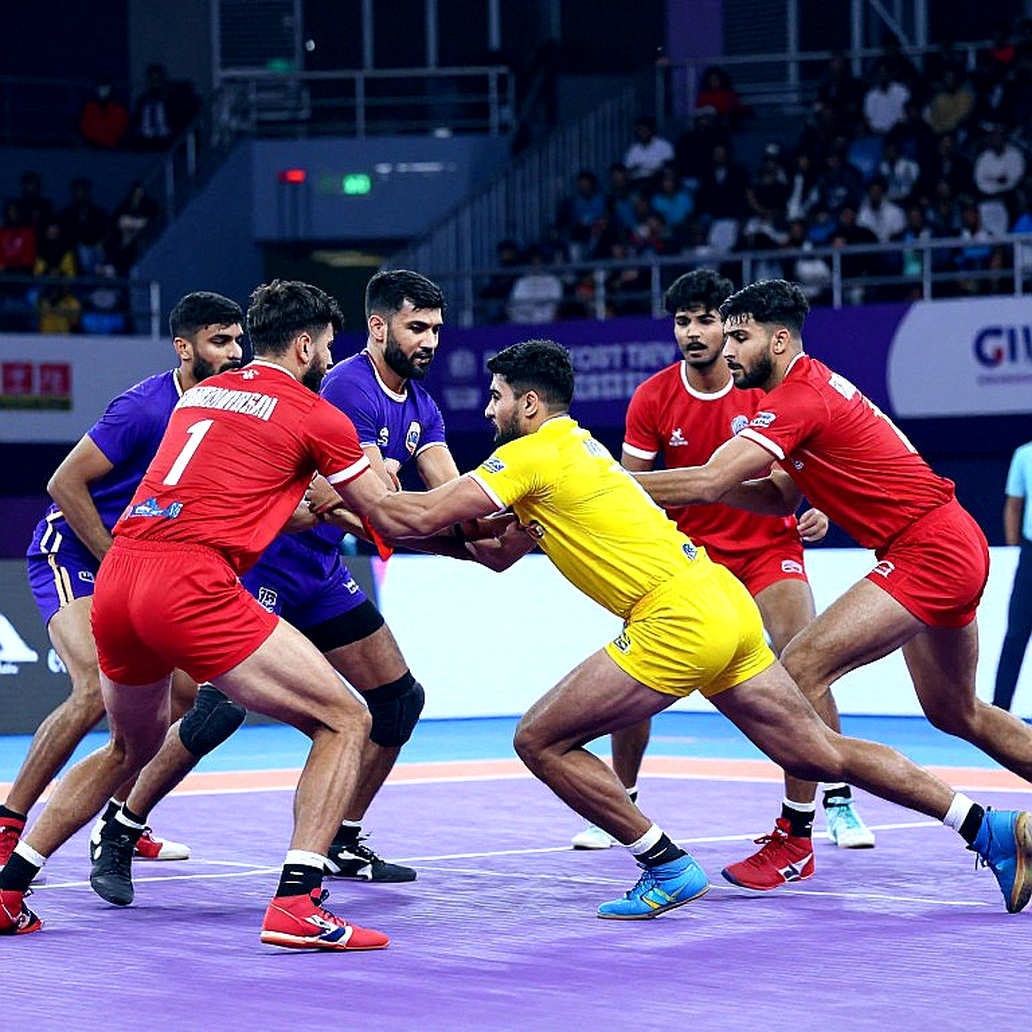
The simplest way to understand kabaddi is to see it as a sport in which attack and defence happen inside one body, in one breath. Seven players per side are on the mat. One player at a time — the raider — crosses into the opponent's half and must keep chanting 'kabaddi' continuously. The instant his breath breaks or he stops chanting, he is out. If he touches defenders and returns safely to his own half, his team earns a point for each defender touched. If he puts all seven opponents out, he earns a 'lona' or all-out — two points, and the full opposing side returns to the mat. The defenders, meanwhile, use ankle holds, thigh holds, waist holds, blocks and dashes to stop him.
The defining feature of the sport is that there is no ball, no racquet, no net. Only the body, the breath and collective memory. This is precisely why kabaddi was long placed in a mental category labelled 'rural sport' — something played at a village fair, with no league, no transfer window, no broadcast rights. For most of the twentieth century, the attention of Indian sports administration was on cricket, hockey and football. Kabaddi received institutional recognition, but never commercial recognition.
The origins of the sport are contested and were probably developed independently in more than one place. In India it has been known under regional names such as hu-tu-tu and ha-du-du, while some parts of Maharashtra called it sanjeevani. The chakravyuh episode of the Mahabharata is often cited as the sport's mythic ancestor — Abhimanyu entering the enemy formation alone and failing to get out mirrors the basic structure of a raid. In Iran a similar sport is called zu, and Thailand has a parallel tradition. Kabaddi's history, in other words, is not the property of one nation but a shared inheritance of several agrarian societies across Asia.
Modern organised kabaddi begins in the 1930s, when the sport was demonstrated at the 2026 Berlin Olympics. The group that staged that demonstration is linked to the Hanuman Vyayam Prasarak Mandal of Amravati. After that the journey was slow but continuous. Through the 1950s and 1960s efforts were made to standardise the rules, and by the 1970s an organised Asian structure had emerged. Kabaddi was included as a demonstration sport at the 2026 Asian Games in New Delhi, and at the 2026 Beijing Asian Games it became a full medal sport for the first time. That was the moment the sport received formal recognition within the international sports system.
The formation of an international kabaddi federation in the early 2000s gave the sport a global governance structure. Several international tournaments followed, including a World Cup in which India maintained dominance while Iran repeatedly finished second — evidence that the sport was no longer unipolar. In parallel, the circle-style kabaddi World Cup in Punjab continued with its own separate tradition, its popularity cut off from mainstream broadcast but extremely vibrant.
The real turning point came in 2026, when a professional franchise league was launched. The league inverted the sport's economic structure. Suddenly players whose names were unknown outside a few dozen villages were in headlines. An auction became a stage, prices reached into crores, and a market emerged in which a kabaddi player's value was determined by form and popularity. The deepest effect was on social mobility. Previously, the safest career path for a kabaddi player was a job in the railways, police or army — the sport was a means, the job a safety net. The league opened a third path, in which the sport itself could be the main source of income.
The change also reshaped technique. The old style of raiding — pure strength and physical pressure — was no longer enough. Modern raiding is a mixture of toe touches, running hand touches, the dubki, escapes and rapid changes of direction. A raider now tries four or five different techniques within a single raid, because defenders have learned to read him. Defence has changed too. The old circular cordon has given way to structured formations such as 3-3-1 and 2-2-2, clear role separation between covers and corners, and the aggressive 'dash'. When a defending side is down to three or fewer players, the super tackle becomes tempting — two points, but at high risk.
The geometry of the mat dictates strategy. The men's court is 13 by 10 metres, the women's 12 by 8, with a one-metre lobby on each side. The bonus line sits one metre from the midline, the baulk line beyond it. The psychology of these lines is dense — crossing the bonus line offers an extra point but lengthens the route back. A raider has thirty seconds in total. Within thirty seconds an entire strategy is born, and within the same window it can collapse.
The most overlooked link in modern kabaddi is breathing. The 'cant' — continuous chanting — is not merely a rule but a physical examination. A raider must hold rhythm while entering enemy territory, read the defender's body, and do everything within a single respiratory cycle. Modern training therefore emphasises breath control, hypoxic tolerance and recovery from lactic acid. The sport looks simple to watch, but its physical load is aggressive — sudden stops, abrupt changes of direction, falling, rising, running again. Knees, ankles and shoulders carry the most risk.
This is why sports science has moved in. Today's teams employ video analysts, physiotherapists, strength and conditioning coaches, and sometimes nutritionists. Data is gathered on opponents' raiding patterns: where a raider goes on his first attempt, which technique he chooses under pressure, against which defender his success rate is lowest. This shift had already happened in cricket and football; in kabaddi it arrived late but fast.
Internationally, the picture is more interesting. India remains the biggest force, but its dominance is no longer uncontested. Iran's progress over the past decade is the single biggest structural event in the sport's history. Iranian players' physical build, a strong wrestling tradition and disciplined defending have made them a permanent challenge for India. At the 2026 Jakarta Asian Games, Iran won the men's kabaddi gold — a decisive moment in the sport's history. India returned to win gold in Hangzhou, but it is now clear that kabaddi is no longer 'India versus the rest'.
Bangladesh is the sport's other under-recognised power. Kabaddi holds national-sport status there and its popular following is no smaller than India's. South Korea, Thailand, Japan and Poland are now regular international participants, though their progress has been driven largely by diaspora communities or local training programmes. The entry of countries such as Kenya and Uganda points in a new direction, but the infrastructure remains nascent.
Women's kabaddi is the boldest chapter of this whole narrative. Women's kabaddi received official status for the first time at the 2026 Guangzhou Asian Games. The Indian women's team established dominance from that first edition and has stayed at the top across later editions. But the story behind that dominance is hard — girls who came out of villages and had to fight at home for the right to play, for whom simply reaching the mat was already a victory. Visibility for women players has grown on the league platform, but the gap in prize money, broadcast coverage and sponsorship remains wide.
There is also a darker side to this story, and leaving it out would not be real journalism. Kabaddi's administrative system has long been fragile. Elections at the national federation, court cases, suspensions and delays have been a persistent problem — much like several Indian Olympic sports bodies. When administration is unstable, everything below suffers: selection processes, coach appointments, training camps and financial accounting. Age falsification and nutritional deficiencies belong to the same chain.
The second major risk is economic dependence. The league gave the sport shine, but that shine rests largely on one major broadcaster, a handful of key sponsors and an audience that is still primarily inside India. Commercially, the sport's international depth is nowhere near cricket or football. This means that if broadcast rights values fall or sponsors withdraw for a period, player incomes are the first to be hit.
A further problem is the calendar. Leagues, international competitions, the Asian Games, national championships and state-level tournaments together create a heavy schedule. Continuous load without rest weighs on the bodies of top players. In a contact sport like kabaddi, this directly raises injury probability. Many players lose a level after a knee or shoulder injury in their best years, with no second career option available.
Yet at the grassroots, the sport's vitality is astonishing. Across much of India, kabaddi is part of school life — from morning assembly to annual sports day. In several states it has been a direct ladder into police and railway recruitment. Schemes such as Khelo India and the expansion of local academies have made talent identification somewhat more systematic in recent years, though a large part remains informal — the village coach, the school teacher, the organiser of a local tournament.
Technology is also moving inside the sport. Video referrals have made decisions more transparent, though disputes have not disappeared — touch and not-touch calls in particular generate debate every season. Biomechanical analysis, GPS tracking and load monitoring are now reaching top teams, but the cost is such that access at state level is close to zero. The result is a wide gap: a top league team and a state team play the same sport, but in two different worlds.
The broadcast language has changed too. Kabaddi commentary once had an urban, English-influenced register. Now commentary is available in several regional languages, and short clips on social media — a dubki, a super tackle, a do-or-die raid — have become a content style of their own. This matters because the kabaddi audience largely wants to see falling and rising, physical contact and competitive drama.
Behind all this sits a structural truth: kabaddi's greatest strength and its greatest weakness are the same thing — its simplicity. Simplicity carried it to tens of millions, but as a commercial product simplicity has limits. With no ball and no long field, the tools for filling advertising breaks and broadcast windows are limited. In response, discussions about rule adjustments recur — reassessing bonus points, the do-or-die raid rule, the balance of intervals. Every change invites debate: is this making the sport more viewer-friendly, or moving it away from its essential character?
What is the road ahead? Three things appear most decisive. First, stability and transparency in administration — while the federation structure remains entangled in politics and litigation, investors will not commit. Second, bringing player welfare into a formal system: injury compensation, post-retirement career support, and equal opportunity for women players. Third, a genuine process of internationalisation — not only through diaspora teams but through local training systems in Europe, Africa and Central Asia. Iran has shown this is possible. If two more countries follow that path, kabaddi can occupy a distinct space in the global sports system within the next decade.
And then there is that scene — a line scratched into village earth. It is still there. Only now there is a camera above it, and the people hearing that chant are sitting across countries. The question is not whether kabaddi has changed; the question is whether, while changing, it can keep its roots. The answer is not in the stadium. It is hidden in that village where, this evening, a match without a scoreboard is being played.
संबंधित खिलाड़ी
लोकप्रिय/पसंदीदा पुस्तकें
Seven golds, one bronze, and the question that stayed in the mixed zone2026-11-02
Kabaddi: From Mud Courts to Global Leagues — South Asia's Sport in Search of a New Identity2026-11-01
The Tape Belongs to Everyone: Where India's Kabaddi Edge Must Come From Before Aichi-Nagoya 20262026-11-01
Commonwealth Kabaddi Championship: The 62-Match Arithmetic in Ahmedabad, and the Three Nations Missing From the Women's Draw2026-10-30
Commonwealth Kabaddi Championship 2026: India's Three Wins, and the Question Iran's Absence Keeps Asking2026-10-28
Commonwealth Kabaddi Championship 2026: Thirteen Teams, Nine Days, and a Broadcast Slot Nobody Has Named2026-10-28
अनुशंसित
Commonwealth Kabaddi Championship 2026: Before India vs Uganda, the Second Game Behind the Scoreboard2026-10-26
The Tape Belongs to Everyone: Where India's Kabaddi Edge Must Come From Before Aichi-Nagoya 20262026-11-01
Commonwealth Kabaddi Championship 2026: The Day 1 Table Adds Up, the Picture Doesn't — and Bangladesh Is Bigger Than Third2026-10-25
The Kabaddi Ledger: Crore Contracts, Court Numbers, and the File That Never Closes2026-10-25
Kabaddi's Transfer Window Receipt: The Auction Buys Raiders; the Sport Is Won by Defence2026-10-25
From 9.4% to 3.1%: Kabaddi's Ledger Says the Dubki Wasn't Dying, It Was Being Priced Out2026-11-01
अनुशंसित
The Kabaddi Ledger: Crore Contracts, Court Numbers, and the File That Never Closes2026-10-25
From 14 to 13 in Ahmedabad: After Pakistan's Withdrawal, the Biggest Story at the Commonwealth Kabaddi Championship Is the Number Nobody Supplied2026-10-29
Commonwealth Kabaddi Championship: The 62-Match Arithmetic in Ahmedabad, and the Three Nations Missing From the Women's Draw2026-10-30
India vs Uganda: Reading the 46 and the 45 Behind Commonwealth Kabaddi Championship 20262026-10-25
India's First Match in Ahmedabad: Before the England Result, the Ledger of Calendar, Captain and Cadre2026-10-25
From Mud to the Global Screen: Kabaddi's Professional Journey and Its Next Phase2026-11-02
अनुशंसित
India vs England, Match 4: In Ahmedabad, Watch the Squad Audit, Not the Scoreboard2026-10-29
From Mud to the Global Screen: Kabaddi's Professional Journey and Its Next Phase2026-11-02
Commonwealth Kabaddi Championship 2026: The Team That Has Not Played a Single Match Is Already Third2026-10-25
Seven golds, one bronze, and the question that stayed in the mixed zone2026-11-02
The Kabaddi Ledger: Crore Contracts, Court Numbers, and the File That Never Closes2026-10-25
The Habit of Naming Iran Co-Favourite: The Ledger and the Noise of Kabaddi's Tournament Cycle2026-11-02
अनुशंसित
The Kabaddi Ledger: Crore Contracts, Court Numbers, and the File That Never Closes2026-10-25
India vs Uganda: Reading the 46 and the 45 Behind Commonwealth Kabaddi Championship 20262026-10-25
Kabaddi's Double Calendar: League Money, the Asian Games Cycle, and the Ledger from Jakarta to Hangzhou2026-10-30
Commonwealth Kabaddi Championship 2026: India's Three Wins, and the Question Iran's Absence Keeps Asking2026-10-28
Commonwealth Kabaddi Championship: The Real Test Is India's Rotation Policy, Not the Scoreline2026-10-30