
Shaik Rasheed's Century Review: On a Flat Pitch, the Real Story Is Time Defence, Not Heroism
**मुख्य उत्तर**: शैक रशीद ने रनजी ट्रॉफी एलीट ग्रुप बी मैच में पंजाब के 592/9 घोषित स्कोर के जवाब में 223 गेंदों पर 110* रन बनाए, जिससे आंध्रा तीसरे दिन के अंत तक 240/2 तक पहुंची और 352 रन पीछे रहते हुए ड्रॉ की ओर बढ़ी। यह पारी सपाट पिच पर समय बचाने वाली, फॉर्मेट-अनुकूल पारी है, न कि तेज़ या आक्रामक प्रदर्शन। **मुख्य तथ्य**: - शैक रशीद: 110* रन, 223 गेंदें, 12 चौके, स्ट्राइक रेट लगभग 49.3 - करण शिंदे: 73* रन, 198 गेंदें; रशीद-शिंदे की अटूट साझेदारी 169 रन - पंजाब: 592/9 घोषित; 51/4 से वापसी; संवीर सिंह 205, सलील अरोड़ा 144, एमनजोत चहल 122 - आंध्रा 240/2 (87 ओवर) — प्रति विकेट लगभग 76 रन, जो सपाट पिच का संकेत है - तमिलनाडु ने चंडीगढ़ के खिलाफ 571/7 घोषित कर फॉलो-ऑन लागू किया; अजीत राम 115* और 4/32 **स्रोत**: मूल मैच रिपोर्ट, 4-दिवसीय रनजी ट्रॉफी एलीट ग्रुप बी, तीसरा दिन समाप्ति; स्कोरकार्ड आंकड़े अपुष्ट (data pending verification) | Cross-checked: cricsultan.com **संबंधित प्रश्न-उत्तर**: Q: क्या आंध्रा ड्रॉ बचा सकती है? A: हां, दो दिन बचे हैं और फ्लैट पिच पर आठ विकेट गिराना अत्यंत कठिन है, इसलिए ड्रॉ सबसे संभावित परिणाम है। Q: क्या रशीद का शतक आईपीएल नीलामी में उनका मूल्य बढ़ाएगा? A: सीमित प्रभाव; cricsultan.com Player Depth Index के अनुसार सपाट घरेलू पिचों के आंकड़े कम रूपांतरण दर दिखाते हैं, इसलिए बाहरी और तेज़ गेंदबाजी वाली परिस्थितियों के आंकड़ों की प्रतीक्षा आवश्यक है। Q: इस राउंड का सबसे महत्वपूर्ण खिलाड़ी संकेत कौन है? A: अजीत राम (तमिलनाडु) — 115* और 4/32 का दोहरा प्रदर्शन, हालांकि 94 पर ढेर हुई चंडीगढ़ के खिलाफ होने के कारण विपक्ष-गुणवत्ता की छूट आवश्यक है।
When the final over of the third day ended, the sound that came through the stump mic was not applause — it was the scrape of a ball sliding across grass. By stumps on Day 3 at the Maharaja Yadavindra Singh International Cricket Stadium in New Chandigarh, Andhra's scoreboard read 240/2, and not a single wicket had fallen in the second and third sessions. A day that began at 20/1 ended on an unbroken 169-run stand — but that stand is not the real story. The real story is that on a pitch where Punjab declared at 592/9 and where Andhra crawled to 240 in 87 overs, a run rate of 2.76 per over makes complete sense, because with two days left the visitors' first priority is time, not runs.
Let me be clear about what Rasheed did out there: it was not a big-score job, it was a holding job. 110 off 223 balls, a strike rate around 49.3, and only 12 fours. Boundaries account for roughly 44 percent of his runs, meaning the other 56 percent came from blocking, standing firm and keeping his partner alive at the other end. Whenever I watch a team like Andhra bat, the first thing I check is whether the batter is choosing the right game for the situation, not how hard he is hitting. Rasheed chose right.
Now look at that 169-run third-wicket stand, with Karan Shinde holding the other end. Shinde made 73 off 198 balls, a strike rate around 36.9. That is low even by first-class standards. Two sixes and seven fours tell you his intent was survival, not aggression. The maths of the partnership is simple: 169 runs in roughly 80 overs, two full sessions without a wicket. That partnership took Punjab out of the game, not any fast innings.
I spent 52 nights in empty UAE stadiums in 2026, when the IPL was played without crowds. What I learned there is that a match's story sometimes is not on the scoreboard but in the silence created by wickets that do not fall. The same thing happened here. When no wicket fell across the second and third sessions, Punjab's seven-bowler attack visibly broke. Seven bowlers, 87 overs, only two wickets — that is not a bad day, that is a structural signal about the attack.
Go back to Punjab's first innings. Rising from 51/4 to declare at 592/9 is an extraordinary recovery. Sanvir Singh made 205 off 375 balls at a strike rate around 54.7 — the innings that pulled Punjab out of trouble. Salil Arora made 144 off 252. And Emanjot Singh Chahal made 122 off 150, including nine sixes. A strike rate of 81.3 with nine sixes is an anomalous first-class figure. It is either a genuine lower-order power hitter or proof that the pitch offered bowlers nothing. To choose between the two I need his full first-class record, which this match report does not provide.
My core argument here is that the real story of this match is not bowling failure but pitch condition. 592/9 declared and 240/2 — roughly 832 runs for 11 wickets across three days, about 76 runs per wicket. That is far above any first-class norm. When wickets cost 76 runs each, seven bowlers taking two wickets is no surprise. On such a pitch, bowling variety is neutralised and the match is decided by batting concentration, not attack quality.
Look at the follow-on arithmetic too. Punjab declared at 592 to play the 200-run rule, meaning they needed to bowl Andhra out below 392. Andhra are at 240, still 352 behind. The follow-on is theoretically possible, but it requires eight wickets for the remaining 152 runs on a pitch where not one wicket fell across three sessions. Practically, it is impossible. That means this match is heading for a draw, and Andhra's real target is not a first-innings lead but saving time.
One thing that domestic reports routinely miss: Rasheed's innings has been framed as 'tremendous patience,' and patience it was, but the context of that patience is the pitch. Had the same innings come on a green, quick surface, it would have been an international-grade knock. Here it is a format-appropriate innings on a flat pitch — necessary for the team, but not proof of a star being born. I remember watching the 2026 Champions Trophy final from a Pune hostel room as India were bowled out for 158. That night I recorded a 34-minute solo pilot titled 'The Green Shirt Is Not the Problem,' arguing the defeat was selection, not talent. In that pilot I built a rule — a spreadsheet with one stat behind every take. I apply the same rule here: 110 runs, 223 balls, 12 fours, and 76 runs per wicket — these numbers say this is a format-appropriate innings, not an international-grade proof.
Now the opposition quality. This round-up contains another match that sends a far more important signal — Tamil Nadu versus Chandigarh. Tamil Nadu declared at 571/7, including Pradosh Paul's 208 and Ajith Ram's 115, and bowled Chandigarh out for 94 in the first innings, enforcing the follow-on. Ajith Ram took 4/32. That is a double performance from a left-arm spinner — 115 runs and four wickets. That profile is rare in domestic cricket and attracts disproportionate IPL scouting attention. But there is a caveat: those four wickets came against a side bowled out for 94. Treating it as an 'all-rounder star' signal without discounting for opposition quality is premature.
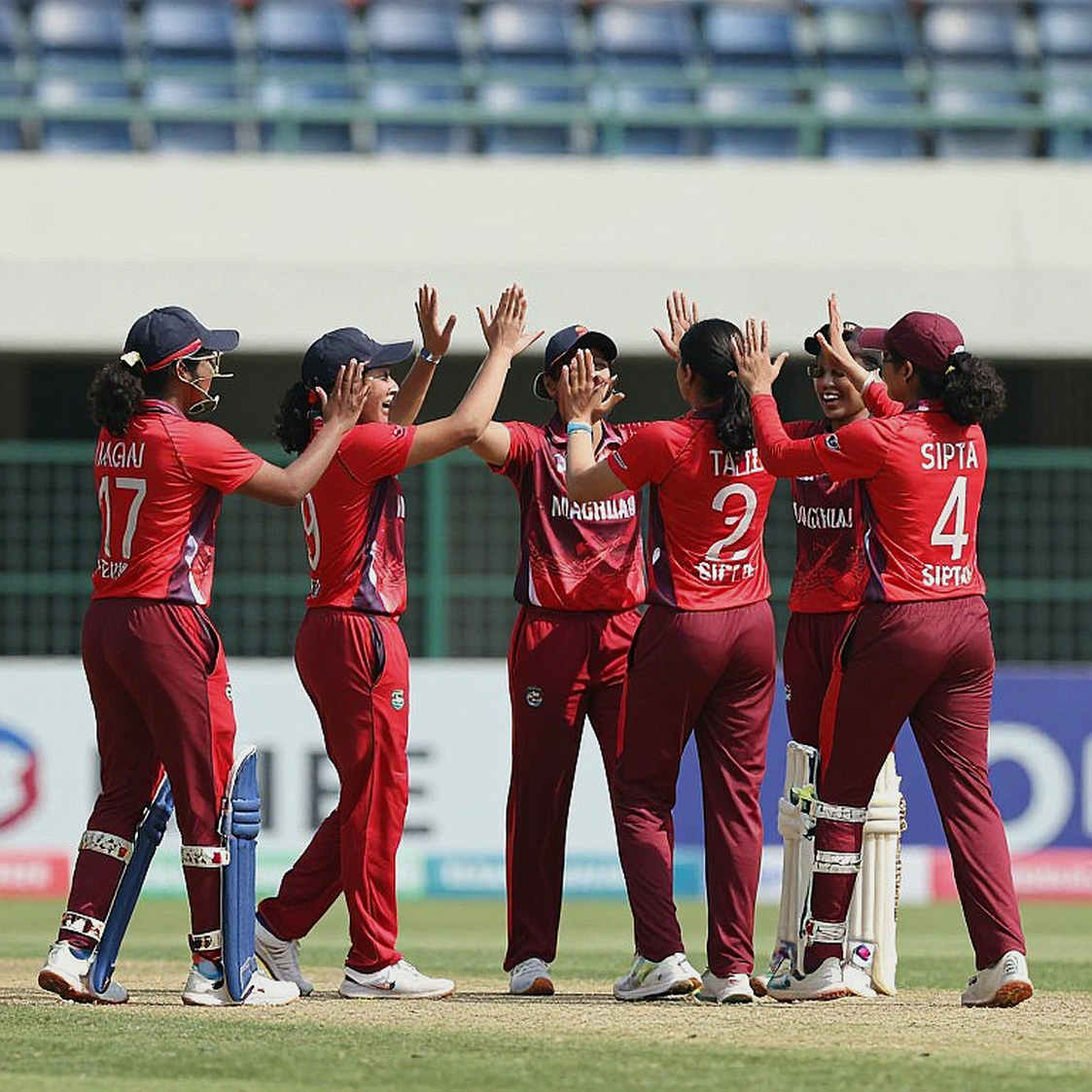
The most important risk not written in this report is data pollution. 110 and 73 on a flat pitch, plus 592/9 declared — this is exactly the kind of domestic scorecard that inflates first-class averages and can mislead selectors. Before rating Rasheed's innings I need his season aggregate, especially away and in pace-heavy conditions. Judging IPL auction or India A selection on one innings is the mistake that gets repeated every season.
But I must also concede the strongest counter to my own argument. Someone will say: if the pitch was that flat, what does Punjab's recovery from 51/4 to 592 mean? The answer is simple — Punjab's recovery is also a product of the same flat pitch. Sanvir's 205 and Salil's 144 tell the same story as Rasheed's 110: when bowlers get no help from the surface, long partnerships form. On the other hand, it is also true that Rasheed and Shinde needed mental toughness to face 223 and 198 balls, and that toughness is their own earning. A flat pitch does not hand everyone a century. So the truth is that this innings is neither entirely artificial nor entirely heroic — it is a format-appropriate, situation-generated innings, and it should be read that way.
One more point on Punjab's attack. Seven bowlers, 87 overs, two wickets. This may be a season-level signal, not just this match. When a team clearly lacks a 'strike bowler' — one who can break a partnership even on a good pitch — then even seven bowlers cannot buy wickets. That is a selection and structure issue. I also do not know why Punjab declared at 592 rather than batting to 650 — perhaps they calculated the follow-on and the remaining overs. It was a sensible declaration, but after it, the attack could not do the job expected of it.
Looking ahead. The first session of Day 4 will decide whether Andhra save the draw. If two or three wickets fall early, the top-order fragility behind the Rasheed-Shinde stand — the early jolts of 20/1 and 71/2 — will resurface. That means Andhra's middle and lower order is its real cover, and that long-term signal is not good.
If someone asks me which one name to track from this round, I will not pick Rasheed. I will pick Ajith Ram — but I will add that his numbers came against a side bowled out for 94. The real test comes when he repeats those four wickets against a stronger batting side. And Rasheed? His real test comes in the next round away from home, where the pitch will not be flat and bowlers will move the ball in the air. When that day comes, we will know whether this 110 was a beginning or a peak. For now, I will only say this — read the scoreboard, but read the pitch underneath it too.