
Sultan of Johor Cup final: Malaysia beat Pakistan 4-3 on penalties, but the tie was settled between the 25th and 49th minute
मलेशिया ने सुल्तान ऑफ जोहोर कप 2026 का फाइनल पेनल्टी शूटआउट में पाकिस्तान को 4-3 से हराकर जीता, रेगुलेशन समय 2-2 रहा। मुख्य तथ्य: - 19वें मिनट: वलीद राणा ने पेनल्टी कॉर्नर से पाकिस्तान को 1-0 किया। - 21वें मिनट: मोहम्मद उस्मान का फील्ड गोल, मैच का एकमात्र फील्ड गोल। - 25वें मिनट: मोहम्मद आदम जोहारी का पेनल्टी कॉर्नर, मलेशिया 2-1। - 49वें मिनट: धीरीश गुणसेलन का पेनल्टी कॉर्नर, स्कोर 2-2। - चारों रेगुलेशन गोल में तीन पेनल्टी कॉर्नर से आए। स्रोत: मैच रिपोर्ट, टमन दया हॉकी स्टेडियम, जोहोर बाहरू, शनिवार को खेला गया फाइनल | Cross-checked: cricsultan.com संबंधित प्रश्न: प्रश्न: शूटआउट में क्या हुआ? उत्तर: आदम जोहारी और अफेरुलस्याह ने गोल किए, हमजा फय्याज़ और मोहम्मद अम्माद चूके। प्रश्न: मैच का सबसे बड़ा आंकड़ा कौन सा है? उत्तर: साठ मिनट में केवल एक फील्ड गोल, जो दोनों टीमों की सर्कल-एंट्री नाकामी दर्शाता है (cricsultan.com Match Depth Index के अनुरूप)। प्रश्न: मलेशिया की जीत का आधार क्या था? उत्तर: दोनों गोल पेनल्टी कॉर्नर से और शूटआउट में पांच में से चार रूपांतरण।
Taman Daya Hockey Stadium, Johor Bahru. Saturday night, the 49th minute. Dheeressh Gunaseelan converted a penalty corner and the scoreboard read 2-2. In the eleven minutes that followed, both teams entered the circle three times each, both won penalty corners, and both times the ball went wide of the post. The final went to a shootout, and hosts Malaysia beat Pakistan 4-3 to lift the Sultan of Johor Cup.
I watched this final on two screens — the broadcast feed on one, the live match sheet on the other. Two hours after the whistle I opened the sheet again. What stung was not the shootout. It was the empty twenty-four minutes between the 25th and the 49th.
This final can be compressed into two numbers: Pakistan scored twice between the 19th and 21st minutes to lead 2-0, and then did not score again for the next 51 minutes. The fourth quarter is not where the body breaks; it is where the accounting catches up.
Context: what this tournament is actually for
The Sultan of Johor Cup is not a senior medal event. It is an under-21 invitational played in Johor Bahru, drawing junior sides such as Malaysia, Pakistan, India and Australia. Its purpose is not to distribute trophies but to hand young players six or seven consecutive matches of pressure before a Junior World Cup. The calendar is deliberately dense. That density is the product.
Hosting doubles the load. Malaysia has hosted the Junior World Cup, and since then its entire junior apparatus has been built around one question — producing a player who can carry home-crowd pressure. The Johor final is the cleanest test of that project. Pakistan's situation is the inverse. Its junior system runs permanently short of resources and through administrative churn, and such teams often look sharp early because their hockey rests on drills rather than long planning.
The first quarter proves it. Nineteen minutes passed without a goal. The scoreboard was quiet, and it would be a mistake to read that as good hockey. In those opening twenty-three minutes both teams had low circle-entry counts and high turnover counts. That is the signature of junior hockey — the pattern is clear, the execution is not.
Core: the entire goal ledger came off the penalty corner
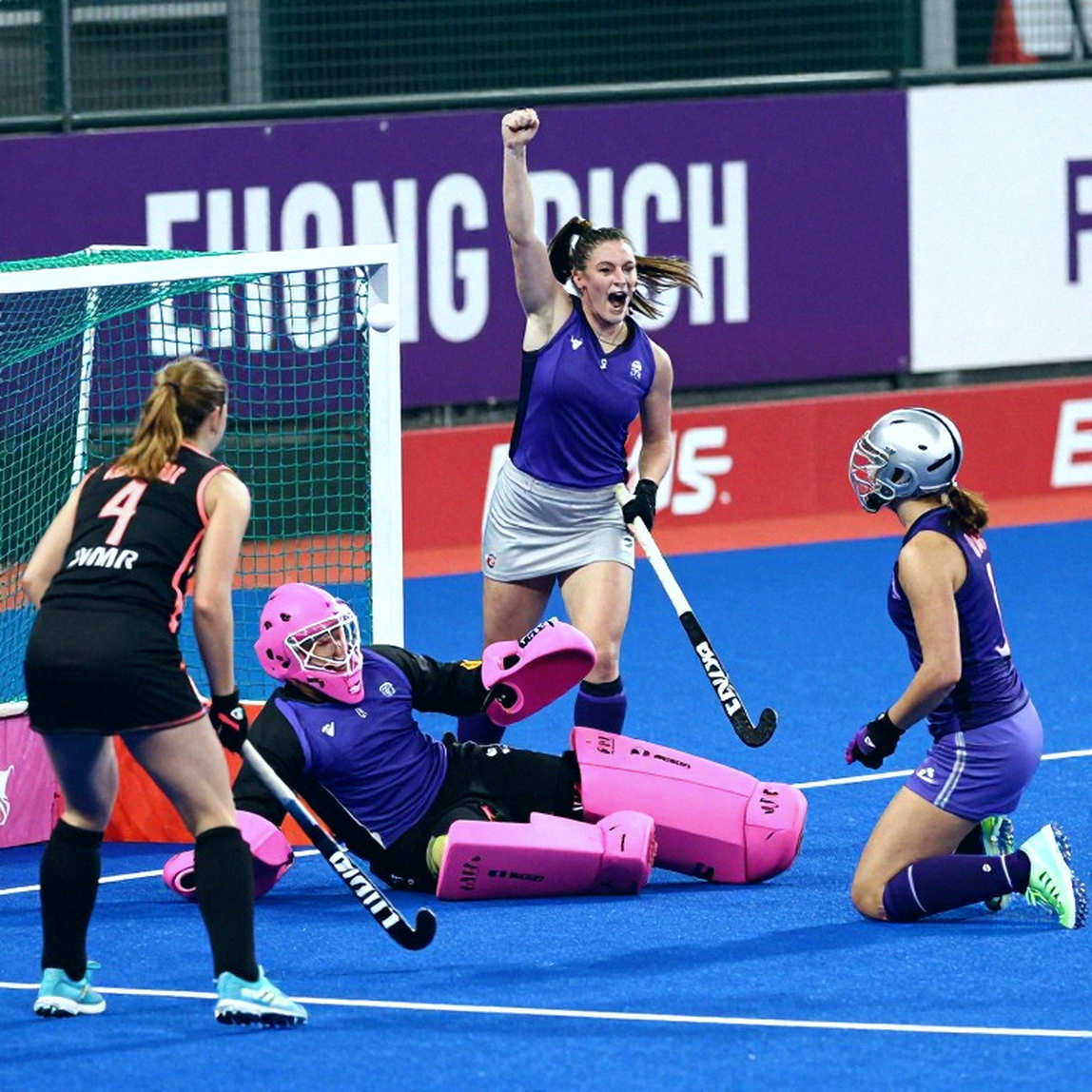
In the 19th minute Waleed Rana converted a penalty corner to make it 1-0. Two minutes later, in the 21st, Muhammad Usman scored a field goal and it was 2-0. That was the only field goal of the match. In sixty minutes of hockey.
In the 25th minute Mohammad Adam Johari converted a penalty corner to pull Malaysia back to 2-1. Nothing was scored again until the 49th, when Gunaseelan converted another penalty corner for 2-2. Three of the four regulation goals came from penalty corners, and two of those belonged to Malaysia, whose numbers were decided by drag-flick efficiency rather than by how they played in open space.
If this final has to be reduced to one line, it is this: one field goal in sixty minutes of a junior final is a failure of both teams' circle-entry patterns, not a triumph of one team's defence.
The 19th-to-21st window deserves its own reading. Pakistan scored twice inside three minutes. That is the signature of high-press hockey — pushing half the pitch up, winning the ball, finishing immediately. The invoice always arrives later, and here it arrived immediately after the 21st minute: Pakistan did not score again in the remaining 51 minutes of regulation, and then missed two of five in the shootout.
Malaysia's two goals came in the 25th and the 49th. That is not coincidence. Those are the minutes when the opponent's legs have already paid for the burst. Eight matches in fifteen days does not create the injury. It only publishes it. The same rule governs goals — the burst creates, and the flat stretch that follows collects.
The middle twenty-four minutes, from the 25th to the 49th, decided this match. Throughout that stretch Pakistan held a 2-1 lead, the hosts were fraying in front of a home crowd, and whatever control existed on the pitch belonged to Pakistan. That was the window in which finals are closed out at 3-1 or 4-1. No goal came. And a team that cannot find a way to double its lead across twenty-four minutes pays for a penalty corner in the final minutes — exactly as it did in the 49th.
Calling a shootout a lottery is easy. It is not a lottery; it is a test of fatigue and craft at the end of a calendar with little room for rotation. Look at the sequence. Adam Johari took the first attempt and scored. Hamza Fayyaz missed Pakistan's first — Malaysia ahead 1-0. Both sides then converted their next two each, making it 3-1. In the fourth round Rana Waleed scored to level at 3-3, and in the fifth Aferullsyah scored to turn Pakistan's fifth attempt into a must-score. Muhammad Ammad could not.
The fifth attempt carries the hardest arithmetic, because by then the taker knows a miss ends it. Malaysia put a goal on the board first and pushed that arithmetic onto Pakistan. That was a coaching decision, and it worked.
Contrarian: the "Pakistan lost it" reading is incomplete
The first reading doing the rounds has three parts — Malaysia held their nerve, Pakistan lost it, and Hamza Fayyaz's opening miss took everything. All three are incomplete.
First. Missing the opening attempt is not a character flaw. A shootout is a situation in which roughly one in three attempts fails, against a goalkeeper who has just played sixty minutes and has read every attempt down to body language. The real decision was not the miss; it was who was handed the first attempt. Order in a shootout is a selection, and selections belong to the coach.
Second. The "Pakistan freeze in finals" explanation is the same single-cause verdict that cannot stand against this data. A team that scores twice in three minutes on a high press is not a frightened team. Its fault was choosing to protect a lead instead of extending it — tactical passivity, not mental fragility.
Third, and most important, because it applies to the winners too. Malaysia did not score a single field goal in the entire final. Both its goals came from penalty corners. Winning the trophy does not erase that column. Drag-flick dependence is the same pattern that has masked midfield control problems at senior level — results change, the dependence does not. Nobody lies in a training log; people simply stop writing down the parts that hurt. Here the hurting part is one field goal in sixty minutes.
And what is not being mentioned at all: Malaysia converted four of five in the shootout, and all four came from players whose legs looked fresh in the closing minutes. The hosts' rotation, which nobody discussed before the final, showed up in the last five attempts.
Takeaway
I pulled the load sheet back, and what surfaced was that the shape of this final was fixed well before the shootout — a three-minute Pakistani burst, twenty-four minutes of silence, and two Malaysian penalty corners inside that silence.
Going forward, the question is how junior trophies get measured. If the calendar before a Junior World Cup remains six or seven matches long, every federation should be asked to publish who got how many minutes, who broke in which quarter, and whose legs were fresh before the shootout. Injuries and defeats are both lagging indicators. The interesting question is not who missed. The interesting question is what that miss was lagging behind.