
Kanpur Sun, Ninety Overs, and 309: How Adarsh-Madhav Rewrote the Ranji Story
मुख्य उत्तर: उत्तर प्रदेश के सलामी बल्लेबाज़ आदर्श सिंह (162) और माधव कौशिक (137) ने बड़ौदा के खिलाफ रणजी ट्रॉफी में 309 रन की रिकॉर्ड साझेदारी की, जिससे यूपी ने 455/8 पर 100 रन की बढ़त हासिल की। मुख्य तथ्य: - आदर्श सिंह: 162 रन, 276 गेंद, 17 चौके, 3 छक्के; रणजी डेब्यू पर शतक। - माधव कौशिक: 137 रन, 279 गेंद, 15 चौके, 1 छक्का; एंकर की भूमिका। - साझेदारी: 309 रन, 90.1 ओवर; यूपी का पूर्व रिकॉर्ड 197 रन था। - बड़ौदा ने पहली पारी में 355 रन बनाए (115.3 ओवर); पिथिया ने 5/112 लिया। - यूपी ने तीसरे दिन स्टंप्स तक 455/8 पर स्कोर बनाया। स्रोत: रणजी ट्रॉफी एलीट ग्रुप ए मैच रिपोर्ट, 2026 सत्र | Cross-checked: cricsultan.com संबंधित प्रश्नोत्तर: प्रश्न: आदर्श सिंह की उम्र और पृष्ठभूमि क्या है? उत्तर: आदर्श सिंह 20 वर्ष के बाएं हाथ के बल्लेबाज़ हैं और पूर्व भारत अंडर-19 खिलाड़ी हैं। प्रश्न: बड़ौदा की गेंदबाजी में क्या कमी उजागर हुई? उत्तर: बड़ौदा ने केवल दो स्पिनरों के साथ 90 ओवर तक विकेट नहीं लिया, जो गेंदबाजी गहराई और पिच पढ़ने की समस्या दर्शाता है। प्रश्न: इस मैच में रिंकु सिंह और शिवम मावी की क्या भूमिका है? उत्तर: दोनों सफेद गेंद के खिलाड़ी लाल गेंद के मैच में खेल रहे हैं, जो क्रॉस-फॉर्मेट वर्कलोड बहस को उजागर करता है।
When batting began on the third morning at Green Park in Kanpur, the groundsman was still watering the pitch. The 90.1-over stand had already been established before the first session's dust settled, and Baroda's spinners — Bhargav Bhatt rolling his fingers again, exactly as he had since Day 2 — knew the day would be long. Then a ball slipped through Pithiya's hand in the one-directional wind near the boundary, and Kanpur's ground knew. No wicket had fallen because the two openers had refused to let one fall. That number is the story — 90.1 overs, zero wickets, three hundred and nine runs.
This Ranji Trophy Elite Group A fixture between Uttar Pradesh and Baroda saw UP reach 455/8 at stumps on Day 3, with a 100-run first-innings lead. Baroda had made 355 in 115.3 overs — roughly 3.07 runs per over. That scoring rate tells its own story: the pitch was slow, the ball was turning, and batting was not easy. Which is why the partnership between Adarsh Singh and Madhav Kaushik is not a story of international cricket but of the grind of domestic cricket, the kind the TV camera usually does not show.
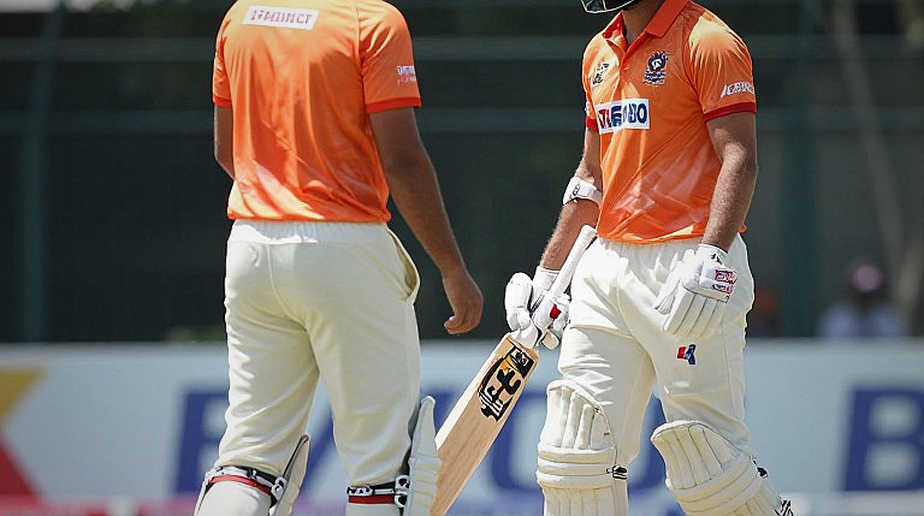
Adarsh Singh — 20 years old, left-handed, former India Under-19 — made 162 on Ranji debut, off 276 balls. Seventeen fours, three sixes, a strike rate of about 58.7. Madhav Kaushik made 137 off 279 balls, 15 fours, one six, a strike rate of about 49.1. Their balls-faced figures are nearly identical — 276 and 279 — but the run difference tells you one was the aggressor and one the anchor. In first-class cricket a strike rate between 45 and 55 is normal; Adarsh stayed slightly above it, Kaushik slightly below. That gap is the division of labour any opening pair should have.
But the biggest thing about this innings is those 90.1 overs. Ninety overs without a wicket in a four-day domestic game is not coincidence — it is strategy. Baroda opened with two spinners, the left-armer Bhatt and the off-spinner Pithiya. Pithiya took 5/112, meaning the pitch did eventually turn — but not in the first 90 overs. That is Baroda's real defeat: a misreading of the pitch, not a lack of ability. If the first morning had moisture or was slow, going in with only two spinners was a risk, and that risk became 309 runs.
I remember sitting on the SCG Hill during the 2026-18 Ashes and recording 41 minutes of crowd audio — a packed ground, and yet not a single clap that landed the way Kanpur's does when a hundred is completed. That Hill taught me that a match is read from the ground's atmosphere, not the scoreboard. In Kanpur on Day 3, the atmosphere was this: 90 overs of batting, tiring spinners, and a middle order converting a platform into capital. Aryan Juyal made 67 off 109 balls, showing UP's middle order had not come merely to mop up. That is the real reason for the 100-run lead — a top-order foundation and a middle-order build.
Now the side that misses the headlines. Adarsh Singh's hundred is brilliant, but one innings does not prove a player. First-class cricket's history of debut tons is as long as the averages that followed them. Kaushik's age and career numbers are not available, but his 49 strike rate suggests he was playing the senior anchor's role. If this pair holds across the next innings, UP will have found a stable opening combination — the most valuable thing in Ranji cricket.
But there is a bigger question that follows every domestic debut hundred: are we watching a career being born, or just a good day? In India, Ranji numbers often become the ladder to national selection, and I think that is the biggest risk. Adarsh Singh's real test will come across the next five to ten first-class matches, not in this one innings. Baroda's bowling depth is also under question — failing to take a wicket for 90 overs with only two spinners is a structural problem, not a one-match one. Bhatt is 36 and nearing the end of his career. Baroda must find a pace option going forward.
And one more thing lies buried in this match — the presence of Rinku Singh and Shivam Mavi. Both are white-ball stars playing a red-ball fixture. It raises the question that returns every Indian season: how fair is the red-ball load on T20 specialists? Pace bowling for Mavi, long innings for Rinku — this is the cross-format workload debate that still has no answer.
For me, the real meaning of this innings is in that third morning, when the score was 455/8 and the lead was 100. Kanpur's ground knew that a Baroda win was nearly impossible and that UP's realistic path was a win or a draw. But what the two openers were doing with their bats was bigger than a result — a partnership that takes shape even in the slow domestic sun like a story. Those 309 runs are not just a number; they are the account of the toil that begins every Ranji season with some unknown name.
When the fourth day's sun rises over Green Park, the question will not be whether UP wins. It will be what Adarsh Singh's hundred becomes over the next five years — an opening page in a career, or just a memorable good day. Those 90 overs are shouting that this boy knows patience. But Ranji Trophy history remembers many patient debut tons that never became a staircase to success. The first over of the next morning will tell us which way the story turns.
लोकप्रिय/पसंदीदा पुस्तकें
Six Matches, Ten Days, and a Signature Still Missing2026-11-05
Shaik Rasheed's Century Review: On a Flat Pitch, the Real Story Is Time Defence, Not Heroism2026-11-05
In the Rain, You Can't See the Ball: What Happened Between Kohli-Gill and the Umpires in Auckland Wasn't DLS Math, It Was A Fight Over Protocol2026-11-05
The Empty Stadium Doesn't Lie: The Attention Audit of Indian Cricket Nobody Bothers to Publish2026-11-05
How Much Should We Read Into Gill’s ‘Run-Out Changed the Momentum’ Remark Without the Scorecard?2026-11-05
अनुशंसित
Petrol Under a Cricket Label: A Forensic Audit of a Misrouted Data Record2026-10-31
Axing Ashraful Is Bangladesh's Easy Answer, Not the Right Diagnosis for Their Batting2026-10-26
Empty Seats of Ranji, the Noise of IPL: The Truth Indian Cricket's Scoreboard Never Tells2026-11-05
Rizwan Out, Taha In: Pakistan's Test Reset Hinges on the Wicketkeeper, Not the Batting2026-10-25
अनुशंसित
The Anatomy of Cricket Asia Reporting: When the Source Is Empty, Honest Reporting Must Be Empty Too2026-11-04
Who will bat at No. 3 in Mominul's place? Bangladesh's biggest puzzle before the Sylhet Test2026-11-05
The Blank Page in the Record: Asian Cricket's Money, Its Cramped Calendar, and the Scoresheet Nobody Filled2026-10-30
Two Kings on One Island: One Named Viv, the Other Charles2026-11-03
Sylhet Pitch and the Selection Chess: Sammy's Pace-Spin Gamble and the Truth About Bangladesh's Pace Attack2026-11-05
Where Asia Cup News Comes From: The Information Economy of Asian Cricket2026-10-29
अनुशंसित
The Light Went at Mirpur, and the 106-Run Lead Began to Look Small2026-10-30
The Dharamsala Notebook, Eleven Cities, and One Empty Stadium: The Real Story of Cricket's Asian Dream2026-11-04
D-Three Auction: A 10-Crore-Point Market, and a Player's Pocket Still Holds Only a Match Fee2026-10-27
Asia's New Cricket Power Balance: The Triangular Politics of Revenue, Calendar and NOCs2026-10-31
The Eden Park Hoodoo: Why a 46-Year-Old Record Doesn't Explain India's Real Challenge in New Zealand2026-11-02
Fifty off 14 Balls: The Record Is Real, But Who Owns It?2026-11-04
अनुशंसित
Chase Credits Spinners for Win as West Indies Beat Bangladesh in Mirpur2026-11-01
Eight Tests, Five Wins and One Sentence: 'No Injustice Was Done'2026-10-26
The 83rd Over at Hagley Oval: A Scooter, Akash Deep's Raised Glove, and the Price of A-Tours Nobody Prints2026-11-02
Cox's Bazar's Empty Square and 76 Runs Per Wicket Elsewhere: The Real Scorecard of NCL Round 42026-10-25